Google’s search engine has evolved significantly with the integration of generative AI. It’s also changed the search engine result page appearance. Now, if you search using an informational keyword, you get a separate section at the top answering your query directly. You get this answer with the help of Google’s Generative AI, which extracts information from multiple authentic websites to provide you with better and more relevant answers. However, you may wonder why this matters. Featuring in the AI Overview section is the top priority for website owners in 2026. This is the new competition among website owners: to be selected by Google as a trusted source for the AI Overview section and tagged with their website link as a resource.
Key Takeaways!
- AI Overview is the top position in the Search Engine Result Pages (SERPs) – the first thing you notice after the sponsored ads (in case any).
- Google’s generative AI processes various relevant websites to answer the most specific and relevant answer to the searched query.
- Website owners can optimize their websites for AI Overview. To do so, they need to focus on technical terms, content quality and relevance, structure of the content, and most importantly the EEAT concept.
- Adding Schema markup, writing in-depth and quality content, and structuring with relevant heading tags, all of these can help you appear at the top of SERP position.
What Are AI Overviews?
AI Overview is the first thing we notice on the search engine results page when searching for a query. It’s presented at the top of the SERPs in a box-like structure with a parent heading called “AI Overview.” This section provides a quick answer to your query in a similar tone to your Google search. The source of answers remains the top credible websites having authority and expertise in a particular niche. Google scans all those websites that include or discuss your topic, and then formulates the answer within a few seconds using Generative AI.
Moreover, from a reference point of view, Google integrates source links directly within the overview text or in a clickable carousel, allowing users to verify the information instantly. However, the information is all merged and answered with the help of Generative AI.
How AI Overviews Work?
AI Overview is powered by LLM, which processes the language and understands the query you search. Using Retrieval-Augmented Generation (RAG), Google fetches real-time data from trusted sites and synthesizes it into a direct answer.
To make it simple, Google first recognizes the query and decides if the AI Overview will be suitable for this. If needed, a well-crafted overview is created for the query using the sources available in Google Knowledge Graph and other useful websites.
AI Overviews vs Traditional SEO Results
There are many noticeable differences between AI Overview search results and Traditional search results on Google. In Traditional SEO, a simple list of websites will be presented when you search for a query. These websites have discussed or have some part of relation to the keyword and its meaning.
However, in AI Overview, the solutions are provided in the top section called AI Overview, even before the traditional results. Also, AI-powered results are very specific and extract the most relevant answers for the query.
Below, we mention the key differences between the two:
| Aspect | AI Overviews | Traditional SEO Results |
| What it is | A quick answer section at the top of the SERP displays the answers deemed most relevant for the query using authentic sources. | Presented as a list of individual web pages (blue links, rich snippets, etc.) selected by classic search algorithms. |
| Main goal | To provide quick and most relevant results without letting users struggle to find the answer. | To provide website links that may prove beneficial for the users. |
| How content is created | The text or quick summary or AI Overview is created by using generative AI and with the integration of LLMs. | The content is written by original website owners, Google does not have any interference in that. Google only shows the most relevant pages at the top of SERPs. |
| Data sources | Content in AI Overview is produced using generative AI that extracts useful information from credible web pages and online data. (Knowledge Graph, Shopping, etc.) | Each result is a single URL evaluated on its own signals (content quality, links, UX, freshness, etc.). |
| SERP position & layout | Presented mostly at the top of the page, leaving organic search behind. | Presented below any AI Overview or other special modules. It’s just presented as the URLs, from most relevant to the least. |
| User interaction style | Users skim the summary, expand sections, or click a small set of curated source cards for deeper reading. | Users scan multiple titles, snippets, and rich results, choosing which sites to visit based on their own judgment. |
| Click behavior & traffic | Increases “zero-click” behavior; fewer users scroll, but pages cited in the overview can see boosted visibility. | Clicks are distributed across many listings; top positions still capture most traffic, but users may explore more options. |
| Optimization focus | Emphasise topic depth, clear sub-question coverage, structured answers, EEAT, and schema so content is “model-ready” as evidence. | Emphasise technical SEO, keyword targeting, on-page relevance, link building, and UX to win and hold high rankings. |
| Commercial & YMYL handling | More conservative; may show fewer or no AI Overviews for sensitive financial/medical topics or defer to classic results. | Traditional results still dominate many YMYL and transactional queries, with stricter quality and trust requirements. |
Why AIO (AI Optimization) Matters in 2026
Adapting to AIO (Artificial Intelligence Optimization) is the need of the hour. The search world is moving fast towards automated features, and AIO is one such. The results are now produced as a query is searched, making it easy for users to find answers without clicking each link and finding the answer.
Here are the reasons why AIO matters in the future:
Rising trend of AI Usage:
AI optimisation is essential in 2025 and later due to the rising demand for it. Now, users are actively participating in using AI tools like ChatGPT, Gemini, Perplexity, and Grok to find the most relatable and accurate information. Noticing that, optimising the website for these tools is the necessity.
Drop in Website traffic:
Websites have seen a significant drop with the more and more use of AI optimisation. Websites that have not optimised for an AI search have a lesser chance of surviving in the flood of this new concept. Thus, sites with AI integration are your requirement.
Rising Voice search trend:
Nobody wants to waste their precious time typing long long paragraphs on either Google search engine or any other AI tools. Better, they have an option to ask their doubt directly by speaking to the given mic option. Since people now ask long and direct questions, website owners have to consider the need to optimise the web page that targets users’ queries directly. Notably, queries that intend to seek information or have many words included are more likely to appear in the AI Overview section. Around 99.9% informational queries are answered in the AI Overview.
Clarity of Information and Trust:
An AI algorithm prefers direct answers to a query. The more clarity it finds on your web page, the higher the chance of getting featured. Along with it, AI prefers trusted web pages, having a topical authority and depth of content, to feature in the AI Overview. Thus, building a topical authority, focusing on topic clustering, and writing clearly will require more. You can also check Backlinko’s view on why AIO matters in the future.
Which Type Of Keyword To Select To Rank In AI Overviews?
Long-tail keywords with Informational intent appear in AI Overviews. The idea behind this is simple: when you type a long keyword to search a query, this indicates you need a detailed answer for a specific query, and therefore, generative AI comes into play.
Moreover, question-based queries are likely to appear in AI Overview with 57.9% chances.
In other words, we can also say that the complexity of the keyword determines the results that will be in the AI Overview. Google’s LLM research fetches the best result based on the query and the data it has.
How To Optimize For AI Overviews
Have a look:
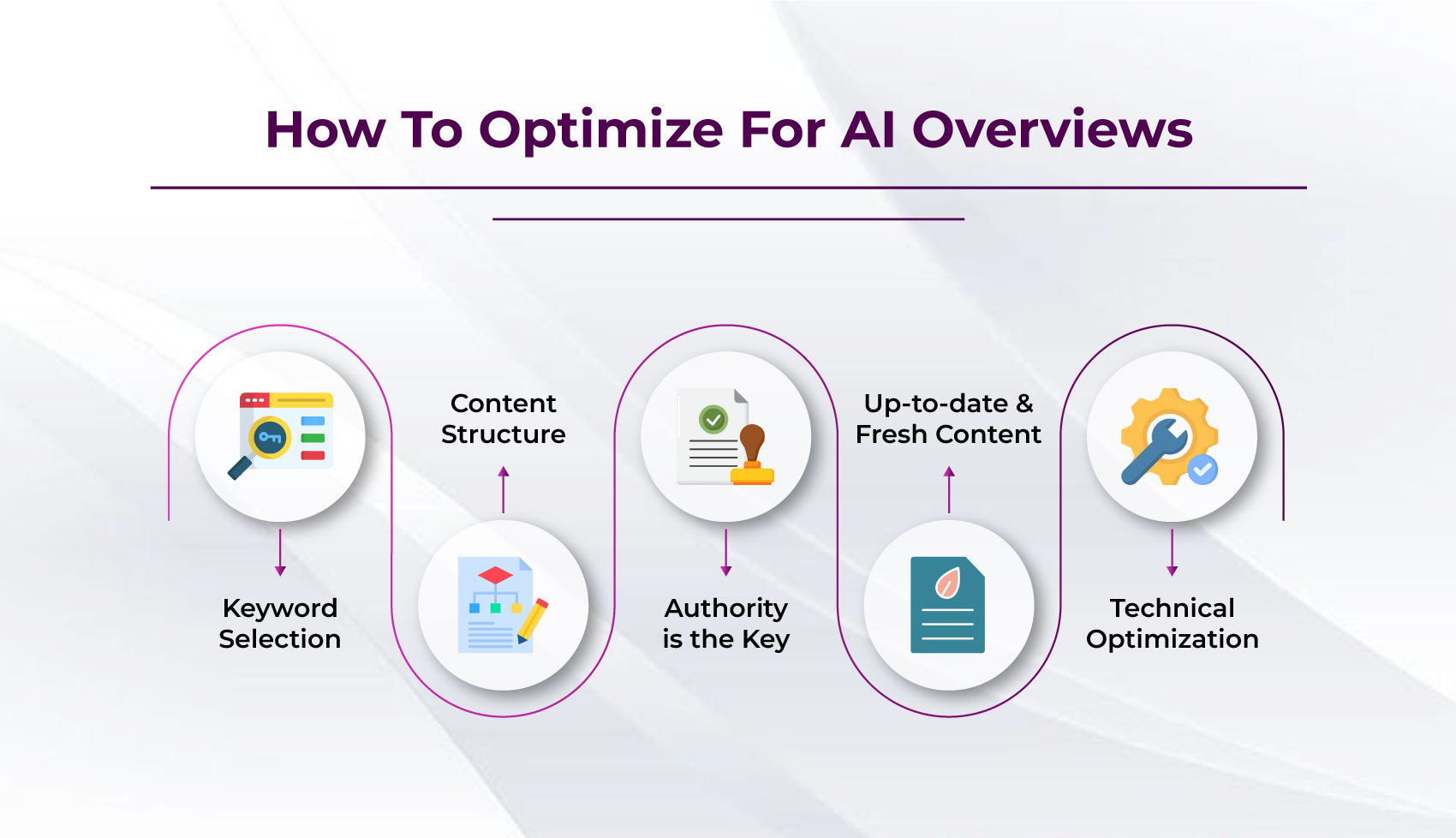
Keyword Selection:
The primary task for a better chance of getting your website featured in the AI Overview section is selecting the right keyword. Long-tail keywords and questions that require immediate answers often trigger AI Overviews. Additionally, informational keywords have a significantly higher chance of being included in the AI Overview. For a better understanding of why this happens, refer to the previous sections. Above all, you have to keep keyword volume, difficulty level in mind.
Content Structure:
The content part is the crucial one; it’s a deciding factor in whether or not you will be considered for the AI Overview. By structure, we mean the relevant headings, content presentation such as bullets, points, tables, FAQs, comparisons, how-tos, etc. Moreover, the answer to the query should be given in a short and simple manner. Plus, following the inverted pyramid style of writing proves to be beneficial. This type of writing gives direct solutions in the first 2-3 sentences (approximately 30-50 words) to the readers at the beginning of the content, and avoids fluffiness and jargon. AI prefers information with more and more facts, data, statistics, etc., which indicates your content is information-rich and written by experts.
Authority is the Key:
Google’s algorithms analyze content relevance and site authority to determine whether your website is worth including in AI search or not. Google gives importance to the website having higher authority in the given niche. Basically, Google follows the EEAT (Experience, Expertise, Authority, and Trust) factor to determine the inclusion of your website in AIO.
Up-to-date & Fresh Content:
The content on your website has to be the latest and fulfil the needs of the users, considering the current situation. In other words, the more updated and fresh content on your site is, the higher your chances of appearing in AI Overview. So, you need to update content, add new sections timely manner, and keep the content fresh and most relevant for the time.
Technical optimization:
Implement robust Schema markup, specifically FAQPage and ItemList, How-to schema, etc. Ensure your content clearly defines entities using About and Mentions properties to help the LLM connect the dots. Ensure Core Web Vitals (specifically INP and LCP) are optimised for fast rendering on mobile devices.
Common Mistakes That Prevent AI Overview Visibility
Here are the common pitfalls that prevent content from being cited in AI Overviews included. These mistakes nullify all the efforts you’re putting to appear into AI Overview position. Have a look:
Keyword/Intent mismatched:
Keywords are the primary requirement, and we cannot ditch this fact. However, sometimes when you overemphasise this and use keywords that are around your primary keyword, then there is an issue. Plus, you lose the intent at the same time. Align keywords naturally with user intent and semantic context. Avoid keyword stuffing—AI systems prioritise semantic relevance over keyword density. Write for the human question, not the keyword metric.
Content is poorly structured:
When your content is not structured well, for example, poor use of heading tags, no use of tables, points, and longer paragraphs, all of these reduce your chance of appearing in the Google AI Overview.
EEAT is missing:
Google prefers websites that have structured content, authority in the niche, and have followed the EEAT concepts like adding author bio, citations, and regular updates to the content. If you’re missing this, you will lose your chance of coming to the AIO.
Future of SEO with AI Overviews
The SEO keeps evolving as the technology advances. After the AI Overview, there are many things that SEO professionals have to adopt in order to make their presence in the AI Overview snapshot at the top position of SERPs. Check what key areas will impact the SEO with AI Overviews.
Quality over Quantity Will Matter:
The content will have a higher probability of being affected. And the reason is simple: the best and most structured content Google will find, keeping the intent induced, your site is likely to be positioned in the AI Overview. The best-written and structured will be in demand.
Optimizing for AI is a priority:
From 2026 onwards, the focus for the website owners shifted from just focusing on the organic search to appearing in the AI Overview. This is because now the search engine results are shown differently – more AI-driven. The zero-click position will fetch the content from reputable sites, and thus, optimizing sites for GEO is necessary.
EEAT is in focus:
Google’s guidelines for building website trust in search engines’ eyes are going to be more relevant. EEAT, which stands for Experience, Expertise, Authority, and Trust, all of these parameters are truly a gateway to appear in the search. This is because any search engine will only prioritize authentic web pages to cover its information in AIO.
New metrics will add up:
Along with traditional metrics, for example, clicks, CTR, and Organic search, a new set of metrics will tell your website is being cited in AI, the appearance of your site in the AI Overview, and many more. This helps track the website easily.
Frequently Asked Questions
Common queries around AI Overviews are answered here!
How do I rank in AI Overviews?
To rank in AI Overviews, focus on Content quality, structure, and authority of your website in the specific niche. Also, focus on long-tail keywords with informational intent. Additionally, following EEAT will increase the chance of getting featured in AIO.
Do AI Overviews replace SEO?
Instead of replacing SEO, AI Overview focuses on boosting the visibility of your site by featuring its relevant content, data in the top section of SERPs. It’s actually a boost up rather than a replacement of traditional SEO.
Is schema required for AI Overviews?
A schema gives a structure to your content, making it easy for Google’s LLM to go through the content. If you add schema like ‘How-to, Article, FAQs,’ your web page is better recognized by Google. As a result, you may appear in AIO.
How long does it take to appear in AI Overviews?
The high authority website can appear in the AI Overview faster than new websites. However, if you have higher-quality content, well-structured with Schema, and most updated to the latest requirements, you may notice it appearing within a few weeks.
Are AI Overviews available in all countries?
An AI overview is available in around 200+ countries as of 2025. It covers 40+ languages; however, it’s limited in some regions due to regulatory constraints and progressive rollout schedules. The major countries having AI Overviews include India, the USA, EU nations, etc.
Conclusion
AI Overview is the revolution for the SEO industry. The feature is focused on answering users’ queries in the simplest and most direct form. To answer, Google prioritizes most authoritative, trustworthy web pages when selecting AI Overview sources. Generally, the top 10 organic results are considered for this. In this guide, we discussed what AIO is, its impact in the near future, and also how to optimize your website to rank in the AI Overview.