Have you ever wondered why certain pages stay on the first page of SERP? The answer often lies in backlinks.
These links play a vital role by
- Increasing authority.
- Enhancing discovery.
- Telling search engines about your valuable content.
- Boosting organic visibility.
In backlinking, quality always matters. A single link from a high-authority domain can deliver better SEO results and increase your website traffic.
Let’s dive in!
Quick Notes!
- Definition: Backlinks, or Inbound links – links from other sites that pass authority to your website.
- Role in SEO: They are link equity signals that help search engines to measure your website’s credibility, relevancy, and authority.
- Benefits:
- Crawlers find and index new sites more easily.
- Growth in referral traffic.
- Credible sources’ backlinks can offer long-term SEO value.
- Boost domain authority.
- Technical Attributes: Do-follow passes SEO value, which improves rankings. No-follow links don’t transfer the website’s authority, respectively.
- Best Practices:
- Prepare high-quality content.
- Effectively guest posting,
- Do ethical outreach, and much more.
- A quality-focused and well-planned strategy leads to boosted results and drives organic growth.
What Are Backlinks in SEO?
Backlinks drive referral traffic from other web pages to yours. In short, these are the hyperlinks from one website to another.
These hyperlinks are important for users who want to increase their website traffic. Apart from that, it will help to increase the site’s unpaid visibility in search engines.
If you create backlinks on reputable, credible sources by adding high-quality content, search engines will be able to know about these and lead to an increase in website traffic. Moreover, there are high possibilities that your content will become more discoverable.
High-quality backlinks from reputable sources can effortlessly enhance the website’s authority by supporting Google’s framework, E-E-A-T (Experience, Expertise, Authoritativeness, and Trustworthiness). This is Google’s quality framework to analyze your content.
While following an SEO strategy, the essential aspect is executing, managing, and reviewing the performance of backlinks. Moreover, if you want to improve the organic traffic for your website, you should implement on-page and off-page SEO strategies. As a result, it helps search engines to figure you out faster.
Why Do Backlinks Matter?
Check out these common reasons why it matters.
- Helps with Search Engine Rankings: High-quality backlinks give an indication to search engines about your valuable and informative content. As a result, it will lead to boosting your website traffic.
- Authority & Trust: These backlinks build your website’s domain and credibility. In addition, it aligns with the guidelines of Google’s E-E-A-T (Experience, Expertise, Authoritativeness, Trustworthiness).
- External Traffic Sources: Backlinks can gain direct visitors from different websites. As a result, it boosts your potential leads as well as your audience.
- Indexing & Discoverability: With the help of backlinks, search engines can easily explore new pages. An enriched, interlinked website has a high chance of getting crawled and indexed faster.
- Performance Advantage: Websites that have strong backlink profiles often stand out in this competitive market, even if the competitors have posted similar content.
Types of Backlinks
Here are different types of backlinks that will help you to know which kind is the best for doing SEO effectively.
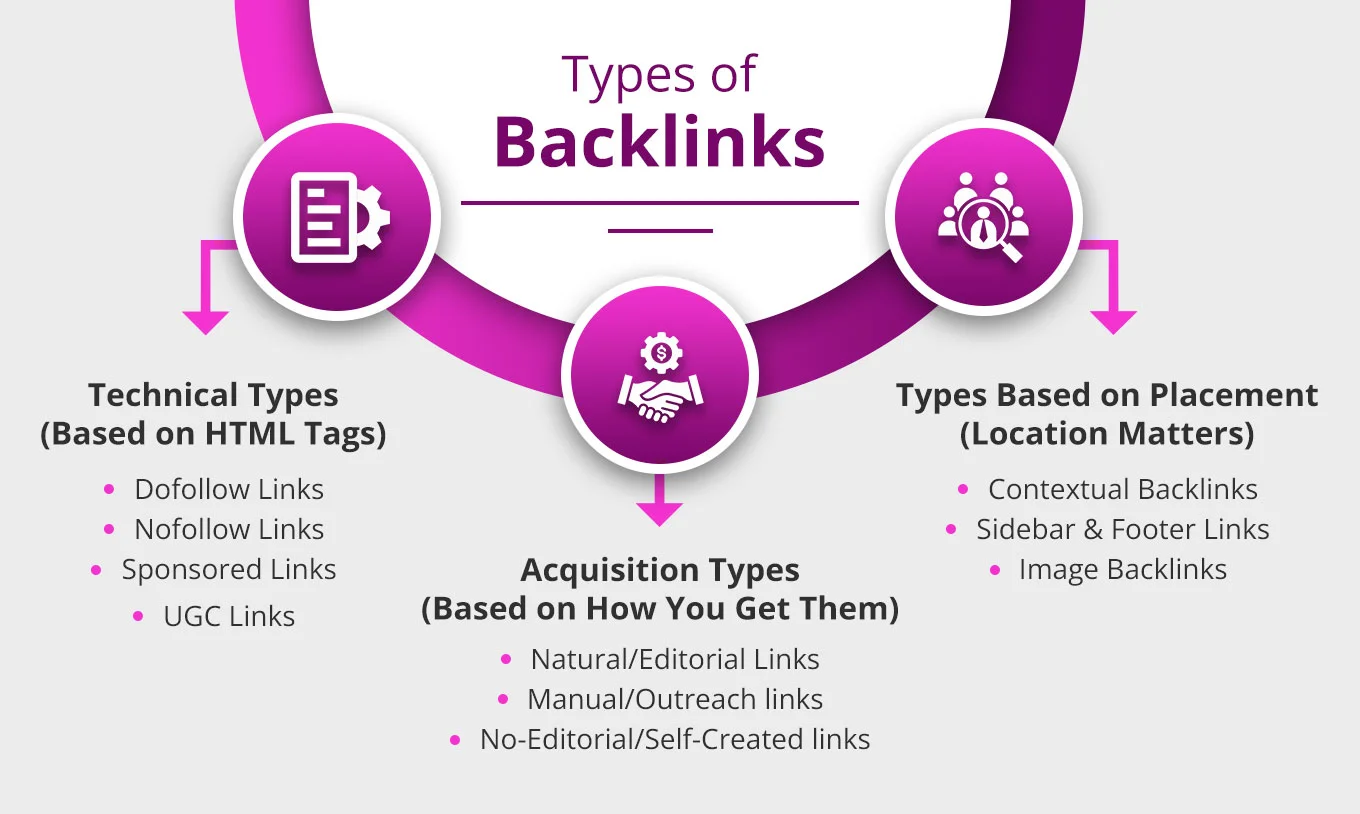
Technical Types (Based on HTML Tags)
These types of links will let you know how search engines treat the backlinks.
1. Dofollow Links
Do-follow links don’t contain any attributes, such as UGC, nofollow, or sponsored. These are the links that the search engine crawlers follow. Besides this, the linking site transfers link equity that helps to increase the website’s rankings.
SEO Value: Premium-quality backlinks can directly help your website to get a higher rank because they provide SEO value, or link juice, from one domain to another.
For example – <a href=”https://spinonweb.com”>Visit Example</a>
2. Nofollow Links
These are the links that contain a special tag—(rel=”nofollow”)—within their code. It symbolizes that website owners don’t want to pass SEO value to the referring domain.
In SEO terms, link equity is also termed as link juice. NoFollow links have a main motive to stop comment spam.
SEO Value: These links don’t pass any link equity. Since 2019, Google has considered nofollow links as indications. In short, it may view the link towards the rankings if it finds valuable information within it. Moreover, nofollow links don’t improve SEO straightforwardly; they are still beneficial because of these:
- Bring referral traffic
- Balance your backlinks profile.
For example – <a href=”https://spinonweb.com” rel=”nofollow”>Visit Example</a>
3. Sponsored Links
Google introduced sponsored links in 2019 to give signals about the link that consists of paid placements or advertisements. It is an attribute that is written as rel= ”sponsored.”
This attribute is applicable to all affiliate links, sponsored articles, and other advertising-related links. In other words, when you pay money to someone so that they can publish your website link, offer free samples or products, or provide any discounts, it all comes under the sponsored links.
SEO Value: With the help of sponsored links, you can easily prevent your website from getting penalized for buying links.
Example: <a href=”https://spinonweb.com” rel=”sponsored”>Check out Example</a>
4. UGC Links (User Generated Content)
These links have an attribute, rel=”ugc,” to let users know about the links that their content has included. This type of backlink was also released by Google in 2019, so that users have a better understanding of the patterns of links.
In addition, these links don’t pass the link equity and increase the SEO rankings. It functions similarly to NoFollow backlinks, preventing the transfer of link equity. Website owners should implement it in various categories, such as forum posts, comments, reviews, and user profiles.
SEO Value: It aids in understanding by Google that the user has created a link, not a website owner.
Example: <a href=”https://spinonweb.com” rel=”ugc”>Best SEO Company</a>
Basic Overview!
| Link Type | Pass Authority? | Main Purpose |
| Do-follow | Yes | Ranking & Authority |
| No-follow | No (mostly) | Traffic & Diversity |
| Sponsored | No | Paid Ads/Affiliates |
| UGC | No | Comments/Forums |
Acquisition Types (Based on How You Get Them)
Here, you’ll learn about three acquisition types, such as:
- Natural/Editorial Links
- Manual/Outreach links
- No-Editorial/Self-Created links
Have a look at these types in detail.
5. Natural/Editorial Links
These are the links that you didn’t ask for, trade for, or pay for. In addition, these are the links that you get without reaching out to the blogger.
In fact, search engines only accept natural or editorial links that are high-quality and authoritative. Moreover, they will provide an indication that you’ve prepared beneficial content, and others will find it valuable.
6. Manual/Outreach Links
Users do manual backlinking in the form of guest posting, writing reviews, doing influencer networking, press releases, commenting on blogs, etc. Moreover, they have a prime goal to create high-quality links rather than a quantity of links.
Apart from that, users reach out to their potential clients via email.
Key Note: This method of doing backlinks is safe as long as you are not providing anything spammy.
7. Non-Editorial / Self-Created Links (The Risky Kind)
These are the low-quality backlinks created by suspicious comments or forums. Besides this, numerous approaches are available, such as forum signatures, blog commenting, directory submissions, social bookmarking sites, or profile links.
SEO Value: These backlinks will be created in low quality because search engines can easily identify that these backlinks are not generated naturally.
Warning: You should not create these links aggressively, as your website can be penalized by Google.
Basic Overview!
| Link Type | Passes Authority? | Main Purpose |
| Natural/Editorial Links | Yes (high value) | Earned organically |
| Manual/Outreach Links | Yes (if quality) | Built through reviews, guest posts, influencer networking, and much more. |
| Non‑Editorial / Self‑Created Links | Low/minimal | Added by yourself. |
Types Based on Placement (Location Matters)
In this section, you will see different types of backlinks on the basis of location, such as contextual, image, and Sidebar & Footer Links.
8. Contextual Backlinks (The “King” of Links)
The links are perfectly placed within the content of another website and are known as contextual backlinks. When you use these links, your content becomes more valuable.
In addition to that, your website’s authority will also be boosted. Apart from that, your link profile will be stronger, and your webpages’ rankings will increase.
9. Sidebar & Footer Links (Sitewide Links)
These are the links that occur on every page of your domain site. Moreover, it is beneficial for navigation purposes. But it is less important in the comparison of contextual links because they offer less SEO value.
SEO Value: Avoid placing too many sitewide backlinks on your website, as it may impact your website traffic.
10. Image Backlinks
This type of backlink usually occurs when a user utilizes any image in the form of an infographic or a pie chart. Users insert these types of links on the image so that when someone clicks on it, the website page will open from where the image is.
Important Point: Search engines use the image’s Alt Text as the anchor text to understand the link
SEO Value: It will drive referral traffic to your web page. By doing this, search engines will be able to find your website more easily.
Basic Overview!
| Link Type | Passes Authority? | Main Purpose |
| Contextual Backlinks (The “King” of Links) | Yes (high value) | Placed naturally within content. |
| Sidebar & Footer Links (Sitewide Links) | Limited | Useful for navigation and branding. |
| Image Backlinks | Yes (if linked properly) | Drive traffic through clickable images. |
Difference Between Do Follow and No Follow
You must understand the impact of backlinks on SEO. But before jumping over that section, let’s take a look at the difference between do-follow and no-follow.
| Aspect | Do-follow Backlinks | No-follow Backlinks |
| Definition | Standard links that let search engines to follow and pass authority (link equity) to the targeted site. | Links with a rel=”nofollow” attribute. Moreover, they are telling search engines not to pass authority to the specific website. |
| SEO Impact | Directly boosts rankings by passing on domain/page authority. | No direct ranking boost. In fact, its authority is not passed. |
| Link Equity | Passed to the linked page. Moreover, it improves its SEO strength. | Not passed. Used as a ranking hint, but does not pass direct PageRank. |
| Search Engine Behavior | Crawlers follow the link and count it as a signal of trust and relevance. | Crawlers may still discover the page, but don’t count it as a ranking signal. |
| Traffic Potential | It can drive referral traffic and enhance organic visibility. | Can drive referral traffic, but without SEO authority transfer. |
| Common Usage | Editorial links, guest posts, resource pages, and high‑quality backlinks from trusted domains. | Blog comments, sponsored posts, paid ads, user‑generated content, and forums. |
| Value in SEO Strategy | Essential for building authority, improving keyword rankings, and boosting organic traffic. | Useful for traffic, brand exposure, and a natural backlink profile (Google prefers a mix of both). |
| Risk Factor | Low risk if earned naturally; risky if manipulated (spammy link building can cause penalties). | Safer for paid/sponsored links since they don’t manipulate rankings. |
| Best Practice | Focus on earning high‑quality, relevant dofollow links. | Use nofollow for paid, promotional, or untrusted links to comply with Google guidelines. |
What Makes a Good Backlink?
Not all backlinks are right for your website. Thus, if you want to build high-quality backlinks, understand the following factors.
1. Authority
Backlinks’ link equity, or link juice, totally depends on the page authority that is linking to you. Moreover, it is measured by Ahrefs’ URL Rating (UR). While there are other tools that may use different metrics, such as DR, DA/PA.
Note: Earn backlinks on high-authority sites to increase your website traffic.
When a webpage is connected to various sites, the SEO value will be lower, and vice versa.
2. Relevant to Your Niche
Backlinks can be more powerful when they are prepared on the same topic that multiple websites are already talking about. For example, if your domain is about digital marketing services and you get a link from an SEO blog, it’s relevant as well as beneficial. But if you get a link from the gardening website, it will not be very effective.
3. Anchor Text
A clickable text within a link is known as anchor text. Search engines look over the anchor texts as well as the words around them. If those phrases are related to the topic, Search engines will be able to understand the link more easily.
Examples of Anchor Text are as follows:
- Bad or Generic: “Read more” or “Click here.”
- Good or Descriptive: “Guide to backlinks” or “Best SEO tools.”
Warning! Don’t use the same anchor text repeatedly so that you can avoid getting a penguin penalty. Maintain your anchor text ratio properly.
- 60% for branded or generic anchor texts.
- 30% for descriptive phrases
- 10% for the same keywords.
4. Placement
The best backlinks are those that are naturally and perfectly placed within the content. Beyond this, these links are much more beneficial because they indicate credibility to search engines and encourage users to click the page.
5. Comes From a Unique Website
Links from diverse and high-authority websites across multiple unique domains are far better than numerous backlinks from a single low-quality website.
6. Do-follow Link Preference
While analyzing backlinks, you should give preference to do follow links over no follow links. Do follow links pass the link equity from referring to the other site to your domain. Also, it helps to boost your website rankings.
On the other hand, no-follow links don’t pass the link authority, but they still increase the referral traffic. However, if you are creating a natural backlink profile, you should keep in mind to include both.
7. From Real & Non-Spam Websites
Good backlinks are earned through reputable, real, useful, and authentic-looking websites that actually support your content. Moreover, it delivers traffic as well as increases SEO value. These come from the contextual sites that transfer the website authority and use good anchor text.
Important Point to be Considered! Backlinks should not be earned from spammy or irrelevant websites.
How to Check Your Backlinks
This section will analyze which sites are linking to you and how these backlinks are impacting your rankings.
Using Google Search Console (For Your Own Site)
- Search for Google Search Console.
- Log in to it.
- Choose your website property.
- Click ‘Links’ in the bottom-left sidebar.
- Examine the reports:
- Top linking sites
- Top linking pages
- Anchor Text or top linking text.
- Choose linking sites.
- Then, click on More for deeper details.
Through Third-Party Tools (For Your Site & Competitors)
- Pick the third-party tool, such as Semrush, Ahrefs, Moz, etc.
- Enter the website domain.
- Look for the links section.
- Here, analyze the sources, page authority, nofollow, and dofollow links.
Pro Tip: You can also check your backlinks with the help of operators, such as yourdomain.com -site:spinonweb.com.
Identify Spammy Backlinks & How to Remove
If there are toxic or spammy backlinks, they can affect your domain authority. That’s why it is necessary to determine those and then remove them.
Detecting Bad or Spammy Backlinks
To identify spammy backlinks, check whether these links come from these sites:
- Irrelevant niche sites
- Spammy sites
- PBN Backlinks
- Sites that are not indexed by Google
- Low Domain Authority or Poor Reputation
- Sites with duplicated content or gibberish text
- There must be very low traffic
- Backlinks from Foreign or Random TLDs
- Sneaky redirects
- Inappropriate sites
Now, we are going to describe how Semrush helps you to detect spammy backlinks.
Using Semrush:
- Search for Semrush’s Backlink Audit Tool.
- Otherwise, consider visiting Semrush.
- Head to the Project Dashboard.
- Choose Backlink Audit.
- Mention your website domain.
- Click on Start Backlink Audit.
- Read the on-screen guidelines. Then, follow them.
- Look for an Overview report. Click on it.
Pro Tip: You can also collaborate with Google Search Console, Google Analytics, and Majestic to get the best and most relevant results.
- Carefully check your backlinks.
- Navigate to Audit.
- Look at the spammy backlinks.
Now, the tool will instantly check itself with more than 45 different indications, such as:
- Linking site’s quality
- Suspicious anchor text, and much more.
After calculating all these signs, it provides you with a toxicity score from 0 to 100 that lets you know how spammy or potentially bad backlinks there are.
- 0-29: Green (Safe) – No action needed
- 30-59: Orange (Caution) – Monitor but likely acceptable
- 60-100 (Red): Flagged links.
Now, see the Anchor column to check the backlink’s anchor text’s category.
- Money Anchor Text: Similar to a focus keyword.
- Compounder Anchor Text: Consists of a brand name.
Removing Spammy Backlinks:
Check out these steps that are performed by connecting with the website owner and using Google’s Disavow tool
Step 1: Check Your Backlinks Profile
Use the advanced tools, such as Ahrefs or Semrush. These tools will offer you an in-depth report of your backlink profile.
Make sure to check:
- Entire toxicity score
- Total backlinks
- Total referring domains, and much more.
Step 2: Get in Touch With the Website Owner
Connect with the website owner and let them know that you would like the link to be removed from their website. Mostly, reputable website owners assist you.
Moreover, if you can manually remove those suspicious links, just do it, as Google also suggests the same.
Otherwise, if this doesn’t work for you, consider using Google’s Disavow Tool.
Step 3. Create a Disavow File
Create a Disavow file. As a result, this file will help Google to know which links it should ignore while analyzing your domain.
Note: It is very necessary to understand in what format you’ve prepared the Disavow file.
If the format that you’ve chosen has errors, Google will not be able to understand that. Moreover, your file can be totally ignored, or it may cause some unexpected issues.
Basic and Essential Requirements That You Should Know:
- Your file should be in a .txt format.
- Must have UTF-8 or 7-bit ASCII encoding code.
- File size should be 2MB only.
- Your content should be prepared with two simple rules:
- For a domain, you should use “domain:spinonweb.com.”
- For a specific URL, you need to insert the full URL, such as https://spinonweb.com/page.html.
- Add comments with the help of the # character.
“Disavow file created [Current Date]
# Domains with multiple spammy links
domain:spammysite1.com
domain:paid-links-network.com
# Individual URL from otherwise good site
https://spinonweb.com/paid-post-page.html”
If you are in doubt whether you should consider the particular URL or the entire domain, go through these steps.
- For domains: The website may have numerous problematic links, or it looks like a manipulative link that comes from a similar site.
- For a particular website: A Specific URL may consist of an isolated link.
What you need to do is simply create a Disavow file by using text editors, such as Notepad++ or Sublime Text. Here, you need to insert each URL or domain on a different line.
Step 4: Submit Your Created File to Google’s Disavow Tool
Check out all the following instructions to complete this removal process.
- Visit https://search.google.com/search-console/disavow-links.
- Pick your website from the list.
- Click on Upload Disavow Lists.
- Add your .txt file.
- Click on the Submit button.
- Google will send you a confirmation message.
Now, let’s understand what will happen after submitting the file.
- Google will take 24-48 hours to complete the process successfully.
- All the links that you’ve given for disavow will be ignored properly.
- You will gain rankings after a few days or months if your website has been penalized.
- Your backlink reports still consist of disavowed links.
When Should You Remove Spammy Links By Using Disavow Links (and When Not)?
Do Disavow if:
- You have received a Google manual penalty.
- Suddenly, rankings have dropped off.
- You have discovered new spammy backlinks.
- There are obvious paid and unauthorized links.
- Your competitor has sent you spammy backlinks to negatively impact your website traffic.
Don’t Disavow if:
- Low-authority links but from reputable websites.
- Google has not penalized you yet.
- Links are genuine and natural, even from low-profile sites.
- There is no negative impact on your site rankings.
The Role of Backlinks in Modern SEO
Backlinks play an important role in modern SEO as they serve as a vote of confidence and give a vital signal to Google to know about the particular domain. In addition, it boosts website authority, generates referral traffic, and increases the chances of indexing and discoverability. Let’s check its role in detail.
It first prefers the site’s authority and topic relevance. But modern algorithms work on the basis of:
- Links should be created from credible and high-authority sites.
- Contextually relevant sources.
- Ignore spammy or suspicious links.
As per modern SEO, it has the main algorithm that it follows: better links = durability of links. In addition to that, relevant, most accurate, high-quality backlinks matter right now, rather than poor-quality ones.
Backlinks are given more importance as they contribute to E-E-A-T, Google’s quality framework. It means that when any high-authority website cites your content, Google automatically thinks that your content is high-quality as well as valuable, which leads to a boost in your website traffic.
All Questions Are Answered Here!
This section will cover the most commonly asked questions and their solutions on backlinks in SEO.
Q1. How to create backlinks for SEO?
Ans. While creating effective backlinks for SEO, you should keep one thing in your mind that the link should be generated in high-quality content. After that, you can do guest posting on reputable sources to gain more traffic.
Q2. Which tool is best for backlinks?
Ans. Ahrefs or Semrush are some of the best tools that help you to identify the type of backlinks.
Q3. Can AI create backlinks?
Ans. Directly? No. However, AI is often used to automate the outreach and content creation that leads to securing backlinks.
Q4. Which backlink is most powerful?
Ans. A dofollow is one of the most powerful backlinks in SEO that comes from a trusted, high-authority domain. Moreover, they are placed naturally in the content without looking like you’ve added them unnecessarily.
Q5. Can Google penalize you for using backlink generators?
Ans. YES! Google can or will penalize you for opting for backlink generators. However, you are trying to violate Google’s spam policy.
Q6. What is a toxic backlink?
Ans. A toxic backlink is generated from an illegal or spammy website of poor quality that violates Google’s quality guidelines. Moreover, these backlinks will badly affect your website traffic and its rankings.
Q7. How to build backlinks fast?
Ans. You need to focus on high-value tactics so that you can build backlinks fast. These are some strategies.
- Optimizing your content.
- Using digital PR platforms like Connectively (formerly HARO).
- Broken link building
- Unlinked Brand Mentions.
- Doing guest posting on credible sources.
Important Caution: Avoid creating too many backlinks quickly (link velocity) in a single day. Otherwise, Google will or can penalize you.
Final Thoughts
Backlinks play a vital role in this modern SEO world. If we talk about some years back, you just needed to build a number of links so that your website could gain domain authority. But now, you have to create high-quality links so that search engines can make your website more discoverable. In addition, it will increase your website traffic and rankings as well. So, what you need to do is focus on creating quality backlinks rather than the quantity ones.