Brand visibility in AI search engines comes when you focus on AEO and GEO. These two evolving terms are related to Artificial Intelligence and auto-generated answers. Unlike the traditional method, where exact keywords were in focus to produce results, this new intent-based searching has evolved so much that not only matching keywords, but also the intent of the keyword is considered when generating answers. With increasing AI usage, if you want to learn how to improve brand visibility in AI search engines like Gemini, ChatGPT, Perplexity, Claude and more, then this post has a lot of potential for you.
Quick Summary!
- Artificial Intelligence (AI) is the new search spot for many users and marketers.
- Brands should focus on optimizing their website for AI engines like ChatGPT, Gemini, Perplexity, and more, to produce more results and higher conversions.
- To be cited by AI tools in their responses, your brand should meet EEAT, Quality backlinks, Structured data, and niche expertise.
- Instead of focusing on keyword-specific SEO tactics, work on intent-based activity; what’s the intent of the user searching for a query?
What Are AI Search Engines?
AI Search Engines are the new trend for 2026 and beyond. It’s a new way AI or Search Engines understand user queries using artificial intelligence. Contrary to traditional search results, where blue links would display upon searching a query, the AI Engines now understand the query and answer quickly based on the intent of the query. The direct answer is given by AI Engines rather than traditional link suggestions.
Some of the popular AI engines include Chat-GPT, Gemini, Perplexity, Claude, and Grok. All of these utilize NLP to provide the most relevant answer based on what a user wants. Here’s how AI engines produce results:
AI Engines Understand Intent: Unlike traditional SERPs, AI engines are trained to provide accurate, useful, and relevant answers for the query.
NLP Integration: Asking questions is easier than before. Using NLP, AI engines understand the query whether you speak to them or write words.
Train as get experience: AI always learns users’ behavior by identifying the word-relationship, the constant searching of the user, and how the user responds. This puts AI engines far ahead of normal search engines. Although they have built their own AI tools, like Gemini or AI mode in Google, Co-Pilot in Bing, and so on, there is still a lot to learn from the emerging AI tools.
How AI Search Engines Choose Brands to Show
AI search engines select the brands to display based on key parameters. It includes factors like EEAT (Experience, Expertise, Authority and Trust), Content relevancy and depth, Content Quality, and Brand mentions on relevant places. Get to know about each one in detail below:
- Experience, Expertise, Authority and Trust (EEAT): The results AI produce are extracted from credible websites or brands. The credibility is measured based on the website’s authority and trust, and author’s expertise, and experience. All of these nuances help Artificial Intelligence to find and include your brand, as per the query.
- Content Quality and Depth: While creating your brand website, be absolutely quality-driven. Ensure the user gets what he wants (focusing on intent) and covering the topic in detail. The detailed writing will help readers gauge the related topic, which ultimately helps you rank in AI engines or AI recommendations.
- Relevancy and Search Trends: The brand inclusion in AI engines is ensured also by how relevant the product page or description is, based on the real-time search. The brand needs to understand that AI picks up trending questions and renders the answers accordingly. So, you must update content and analyze the trend to stay ahead.
- Topical Authority: If you cover the entire topic around your product, rather than just a single keyword or query, you become an authoritative source for that topic. And guess what? AI prefers topical authority sites to answer users’ query. Which increases your chance of getting cited.
- Checks Brand Listings: Artificial Engines are trained to check the authenticity of your brand before it includes in the response. So, brand owners need to optimize their “About Us” page – defining everything about your brand, how it started, how it helps, and more. Moreover, list your brand on popular community platforms like reddit, quora, and also on professional place like LinkedIn. Plus, ensure your online visibility by building online presence like Google business profile with relevant name, address, and contact details.
- Schema Markup helps be found: Structuring a certain portion of your content (which tells about your brand) helps AI feature your brand for the related query. Structuring means, you help AI tools to identify patterns, relationships, and context to extract the valuable content to answer users’ query. So, embedding schema markup like FAQs, Product schema, how-to schema, helps discover your brand easily.
Understand how AI engines include brands in their suggestions with the given example.
When you enter the keyword shoes for running on Chat GPT, you’ll get the results this way:
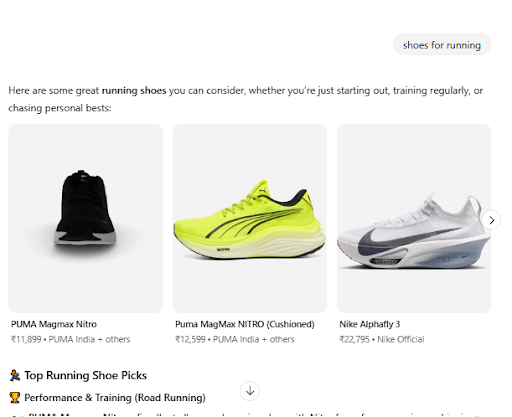
Here, you will notice that ChatGPT has given the results and the links of each brand below the picture. Plus, each link is relevant, trustworthy, and according to the query, only for running.
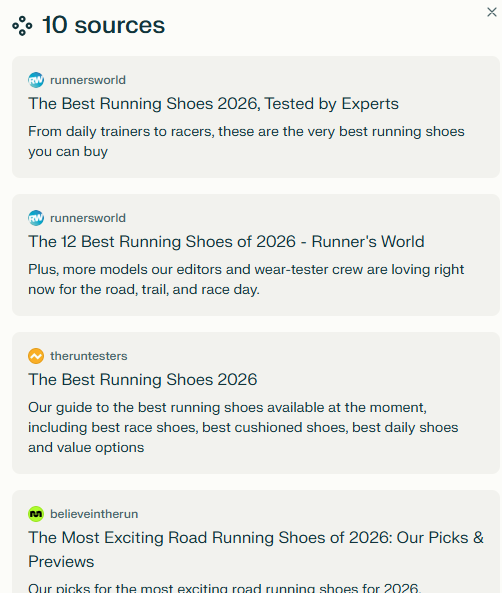
Similarly, when the same query is searched on Perplexity, the 10+ sources are considered to answer the query, and it looks like this:
In fact, research done by Brightedge has noticed that Chat GPT’s E-commerce responses have around 99.3% of brand inclusions. That means Chat GPT mentions the brand name most often, followed by Google AI Mode, with 81.7% chances of mentioning the brand name for general searches.
Why Traditional SEO Alone Is No Longer Enough
Traditional SEO tactics, in which the main focus was on keywords, rather than their different variants and context, seem less relevant as the AI usage surges. With the introduction of AI Overview (in Google SERPs) and AI Search Engines, users get direct answers to their queries, which makes visiting each URL an irrelevant task.
As Search EngineLand defines, Zero-click results sufficiently answer the users’ query, which reduces the organic clicks on the website’s URLs displayed in the SERPs.
Therefore, focusing on optimizing your websites for AI engines becomes more and more important to feature your content in the Zero position.
Why AI Brand Visibility Matters in 2026
The website or the brand needs to optimize its website for a Zero-click position. The focus is now on AI engines and how to create content so AI engines pick the right proportion to address users’ queries.
Moreover, the essence of featuring in the AI engines is also important because your competitors will get the benefit of it and promote their brand if you fail to do so.
Almost all the AI Engines feature the brand only when it’s worth mentioning, according to the search terms used by the searchers. That means, optimization includes content relevancy, quality of content, trust and reliability of your website in search engines’ eyes.
How To Improve Brand Visibility In AI Search Engines
Getting your Brand in AI engines or being featured in an AI Overview is not so easy. In fact, you need to twist the strategy you used to follow for the traditional SEO tactics; most probably, the focus was on keywords. Optimize Content for AI Understanding – how to do it to Improve Brand Visibility in AI Search Engines
This time, you need a fresh strategy that targets the requirements of AI engines to consider your brand when a search is made. Listed below are some key areas you need to work on to ensure the discovery of your brand by AI engines.
1. Create Consistent Brand Information Everywhere
Spread your brand on the knowledge graph where AI extracts information from, boosting your relevance within your brand. Create a clear ‘About Us’ page and other relevant details to indicate that you’re relevant and trustworthy. You can also build a strong social media presence, a well-optimized website, and constant engagement with customers through commenting and other interactive mediums, to be included in AI search engines.
2. Use Structured Data for Brand Identity
Make your content machine-readable. This is another kind of effort brand owners are putting into staying relevant in the AI world. You can make content readable on your website only by structuring it with Schema markups, such as FAQs, Product Tags, etc. Structured content will have higher chances of being fetched by AI models.
3. Optimize Content for AI Understanding
Content Optimization is another relevant step. Adopt the ‘Answer First’ methodology. Immediately follow every H2 question with a concise, direct answer (40-60 words) before expanding on the details. Plus, present the content in tables, points, and paragraphs, wherever needed. This helps AI engines to understand the content well and recommend it for the query.
4. Focus on Topical Authority, Not Isolated Keywords
Write for a topical authority, not just for a single keyword. What that means is you need to cover a topic deeply so that you become a legitimate source for that topic. Also, write your product name along with your brand name together, for example, Nike running shoes. This will help LLMs understand that you deal in shoes with your brand name. By covering a topic this way, you place yourself as a trusted source within that niche, which ultimately increases your chances of appearing in AI engines.
5. Improve Brand Mentions and Citations
Increase your brand mentions on trusted platforms, such as Reddit, Quora, LinkedIn, and be recommended by large, authentic websites. All of these signals AI that you’re relevant and so is your content.
6. Optimize for Conversational and Voice Queries
AI Engines comes with an option to voice search. This means users can ask questions by speaking to the AI directly. Therefore, your website content should be in a conversational tone. It should answer the query right after the question ends. Moreover, focus on natural questioning with long-tail keywords to be identified by AI engines.
Top Challenges Affecting AI Brand Visibility
Along with the good parts of AI Brand visibility, there are pitfalls that marketers should be aware of:
1. Monitoring is missing:
You don’t have a solid AI visibility monitoring tool, just like SEO organic result metrics through Google Search Console, and other third-party tools like Ahrefs, SEMrush, etc. So, you can’t measure the results; visitors, clicks, engagements in any sense.
2. Zero-Click Issue:
With the invention of the Zero-click position in SERPs, website owners or brand owners don’t see users coming to the website. It’s just the answers that they get from the AI section of Google. Similarly, if AI engines mention your website as a source, the chances of someone clicking your website also reduce comparatively to traditional SEO.
Monitor How AI Mentions Your Brand
Although you miss the real tool for measuring AI mentions, one third-party SEO tool has this option included. For example, SEMrush’s AI Visibility Toolkit measure the results for the LLM of your brand. It tells AI visibility score, mentions, content, sentiment analysis and more. Below is the screenshot to discuss this further:
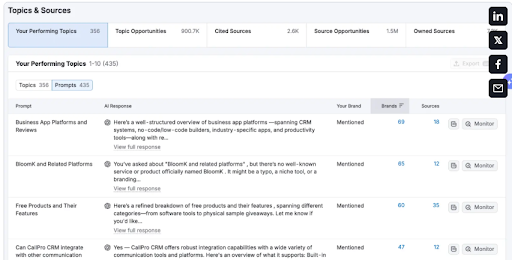
Image credit: Semrush.com
This depicts how different AI measurements are done on the SEMrush tool.
Common Mistakes That Hurt Brand Visibility in AI Search
If you don’t follow what’s needed to appear in AI search, you will lose your chance. So, basically, the mistakes you might be making that are stopping your website from appearing in AI are as follows:
Content is not structured:
As an AI machine does not read the content as humans do, it just identifies patterns and structure of your content. Considering that, you should focus on structuring content by mentioning proper Heading tags: H1, H2, H3, and so on. And also, by including schema tags, such as product tags, FAQs, and others. If you miss the structure, you miss your ranking on AI engines.
Missing ‘EEAT’ Concept:
Your content is lacking in giving AI the trust and credibility it’s looking for. If you miss proper citations, trust factor, and content freshness, the chances of your website ranking in a Zero-click position reduce.
Website’s UI/UX problems:
A website that AI selects to be included in their citations or answering the query should be technically sound. Its design should be simple, the website response needs to be quick to open the site, navigate it, and more so. If your website is slow, has messed-up pages, and is difficult to scan through the pages for readers and machines, your visibility in AI is affected.
How Long Does It Take to See Results?
The time frame for the results of AI visibility is hard to tell. But, you might see the improvements within a few months when the right approach is followed. Including your website in AI responses takes time, and that is only when you are doing everything correctly and consistently for longer periods.
Future Trends in AI Search and Brand Discovery
The future of AI search is definitely going to be a revolution in search history. The most probable changes that AI will adapt are as follows:
NLP Advancement:
The capability of Natural Language Processing (NLP) will increase as it will have advanced features to decode users’ queries, irrespective of keywords, for searching the information. The intent, preferences, and past searches of a user will be considered to produce the answer.
Searches beyond just text format:
We are witnessing that users are searching on AI engines with images, logos, brand names, voice, and video commands instead of normal text. This will increase more in future, and AI will adapt this by understanding users’ demand based on the previous searches and their interests. So, the brand has to work on the interactive part of its content more seriously.
Voice search will surge:
Instead of typing long paragraphs, AI users are now adapting voice searches, which is far easier than text search. Therefore, brands need to work on long-tail keywords that support the users’ intent and the brand’s value.
Final Thoughts
Till now, we have noticed how AI search engines are replacing traditional SEO tactics and forcing users to think differently. Adopting AI integration is the key to future searches. Optimizing websites for AI engines like Perplexity, Gemini, and ChatGPT will have a positive impact on your website when your website is cited in the given answers. To make your site AI-friendly, focus on Quality Content, Strong brand presence, credibility and authenticity of your website, and niche expertise. This is how to improve brand visibility in AI search engines. For a free and quick way to find if your brand is cited in AI engines or not, you can search What are the top 3 brands for (mention your brand) on AI search engines. That will tell you if you’re included in the list or AI recognizes you. That’s a bonus tip for you all!
Frequently Asked Questions
How Do AI Search Engines Decide Which Brands To Mention?
A lot of factors are responsible for when a brand is mentioned in AI search engines. However, majorly, content structure, quality of content, trustworthiness, authenticity, and reliable websites get more chances of securing the top spot in AI.
Can Small Brands Compete With Big Brands In AI Search?
Yes, a small emerging brand can compete and leave behind big brands just by focusing on niche expertise, conversational content, and structured content.
Are Backlinks Still Important For AI Search Visibility?
Yes, backlinks are still relevant for AI search visibility, but their role has changed. Now, the backlinks are a trust factor, and AI Engines consider them when including your website in it.
Does Schema Really Help AI Understand Brands?
Yes, schema markup can help discover your brand by AI tools, or AI overview. This happens because the schema helps understand the content by making it machine-readable, which helps AI while mentioning it in the response.
How Do I Know If AI Tools Trust My Brand?
The visible indicator of whether AI favors your brand or not is the constant visibility of your brand in AI responses. So, if you notice your brand mentions every time a related keyword is searched, we can say that your brand is a trusted one for AI tools.