
Keyword research is an essential part of SEO. It’s one of the first activities performed in SEO practices to determine which keywords, terms, or phrases users are searching for. Many website owners, especially beginners, may find keyword research unfamiliar, but it is not new. This post will guide you through keywords, their importance, and how to do keyword research for SEO.
TL;DR:
- Keyword research is like making a foundation for your entire SEO strategy.
- Through keyword research, you delve into your audience’s mind and find what they actually want.
- Keywords with low difficulty and decent volume metrics are more likely to perform on SERPs.
- Based on intent, keywords are of 4 types: Informational, Navigational, Commercial, and Transactional.
- Analyze competitors’ keywords: find gaps in their keyword strategies using tools such as Ahrefs, Semrush, and others. In the end, understand the intent and craft content.
What Is Keyword Research in SEO?
Keyword research is the process of finding search terms your potential customers use to find products or services online. It’s the analysis of the keywords people search on search engines, social media platforms, and other online platforms. Researching “key terms” or “SEO keywords” is necessary for a business to stay stable and grow within its niche
Search terms are the main words users use to find your product (if your website is optimised for that term). Doing keyword research helps you understand your audience’s intent and what they want. To perform keyword research, you have several options, including Google’s automated suggestions, free keyword research tools, and paid tools.
Why Keyword Research Is Important for SEO Success
Keyword research is an important activity for an SEO campaign because it’s a deciding factor in what kind of information you want to add on your page, or in other words, which intent you’re targeting. The websites that have optimised their web pages based on keyword discovery are more likely to produce results, as the pages get traction in terms of high CTR, Clicks, and conversions.
In other words, Keyword research is helpful to find the ‘Intent of customers.’ As a result, you can cover related content and satisfy users’ needs.
Types of Keywords: Identify And Execute
Keywords can be categorized based on two parameters: intent (for which the user is searching) and length. You can find more on this below.
Based on INTENT:
- Informational Keywords – those keywords users search to get information only; they just want to be informed.
- Navigational Keywords – keywords that are used to reach a particular website, brand, or a particular page.
- Commercial Investigation keywords – intent to search from a buying perspective; the user wants to buy things and is doing pre-buying research.
- Transactional keywords – the user is all set to buy the product and thus wants to make a payment for the product.
Based on Length and Specificity:
Another type of keyword is based on their length. Check below for more information.
- Short-tail Keywords: keywords with 1 or 2-word phrases. Example: Shoes, running shoes
- Mid-tail keywords: keywords with 3 to 4-word phrases. Example: running shoes for women
- Long-tail keywords: keywords with more than 4 words. Example: lightweight running shoes for marathon training.
As you can see, the longer the keyword, the intent is clearer and usually has lower competition as well.
Understanding Search Intent Before Choosing Keywords With Examples
Search intent is the purpose behind a keyword. Since no single tool can fully determine intent, you should combine manual SERP analysis, keyword tools, and your own business goals to choose the right keyword.
We have mentioned some ways you can try out for finding intent behind a keyword:
1. Manual search:
Just focus on your Seed keyword. Type the seed keyword in the search bar of the browser, and observe the results.
When you search for a keyword, the SERP tells you more about what kind of keyword you are targeting. To give you an example, here are the results you can come across:
- If you see “People Also Ask” or “Featured Snippets”: The intent is likely Informational. You need to write a guide or a blog.
- If you see “Google Shopping Ads” or Product Carousels: The intent is Transactional. You need a product page or category page.
- If you see “Comparison Tables” or “Top 10 Lists”: The intent is Commercial Investigation. You need a review or comparison article.
- If you see a brand’s website ranking: It is a Navigational keyword; it can be hard to rank for as a beginner, but if it’s your brand, you’re at an advantage.
For your understanding, consider how a single query with a little twist changes its intent.
| Keyword Example | User Intent | What Content You Must Create |
| “Coffee Beans” | Mixed/Informational | A broad guide explaining types of beans. |
| “Best Coffee Beans 2026” | Commercial | A listicle reviewing the top 10 brands. |
| “Buy Arabica Coffee” | Transactional | An e-commerce product page with a ‘Buy’ button. |
| “Starbucks Menu” | Navigational | Do not target this unless you are Starbucks. |
2. Tools to Find Intent:
Keyword tools such as Ahrefs, Semrush, and Ubersuggest can help identify intent, but they should support your analysis rather than replace it. To find out, just type your keyword on one of the tools and get to know the intent.
3. Analyzing “SERP Reality”:
Analyze the results after you search a query on search engines. What kind of results does Google offer you? Is it a video? Table? Bullet Points? Images? This gives you an idea of how deep you need to cover the topic and in what format so it helps users.
Understand this and then optimize website content accordingly.
How to Do Keyword Research for SEO & AEO:
Researching relevant keywords is necessary for holistic SEO growth. Here’s how keyword research is performed.
1. Identify Your Niche:
First, you need to figure out your niche or topic you’re about to cover on your website. Your topic will define your goal: what you want to achieve through your website. Once your goal is clear, you start outlining the blog, targeting the user.
2. Start with the Seed keyword:
The second step in the process is to start with the seed keyword. Suppose mobile phones is your seed keyword. Enter the seed keyword in the search engine’s bar, and you will get different kinds of phrases users are searching currently for that. Select from them considering the business goal you may have. Beyond manual search, you can also use free keyword research tools like ‘Google Keyword Planner’ (GKP), AnswerThePublic, and Ubersuggest as a beginner to brainstorm different keywords.
These platforms will give you a basic idea of the variety of keywords supporting your seed word. You can pick from here and keep it aside in the document for further reference.
3. Focus on keyword metrics:
In the Keyword selection process, essential metrics like keyword volume, keyword difficulty, and keyword intent are all considered to ensure if the keyword has potential to rank well on the SERPs. If the keyword is of high Keyword difficulty (KD), new websites will be less likely to rank. Similarly, if you select a low-volume keyword, ranking even in the first place won’t satisfy your need – low volume means you will have limited reach to the potential customer base.
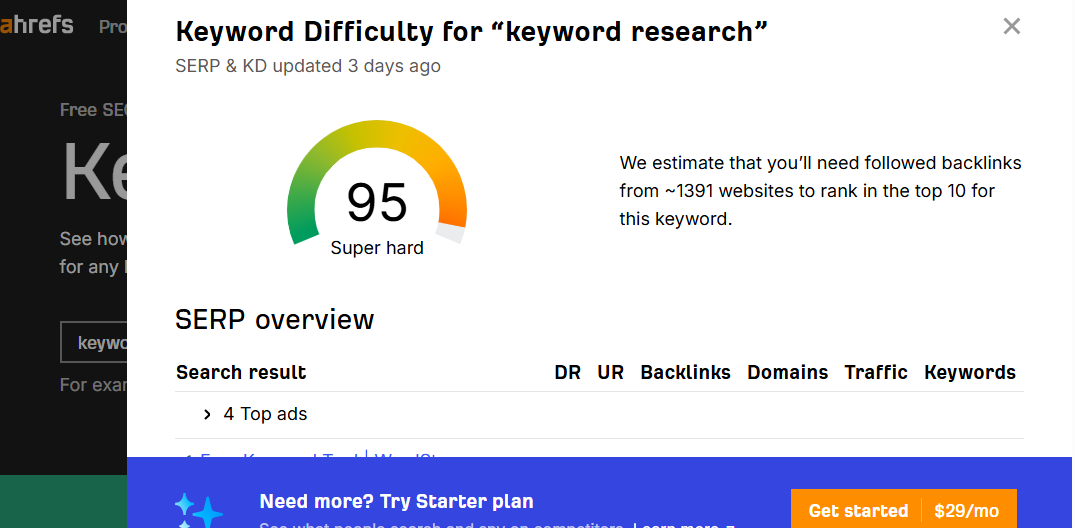
To find the keyword metrics, you can use Ahrefs’ keyword generator, keyword difficulty checker. Taking an example of Ahrefs’ Keyword generator tool.
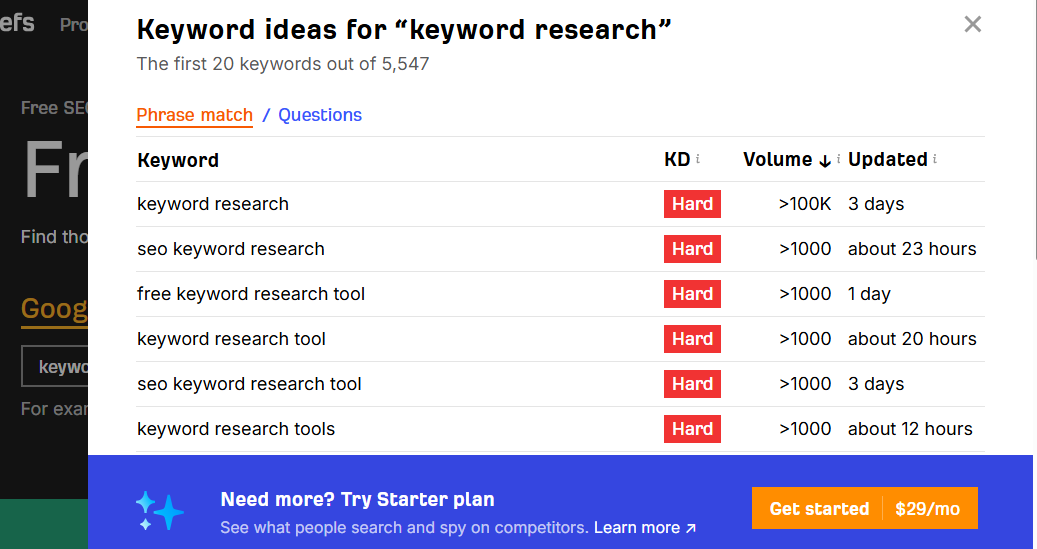
Ahrefs’ Keyword Difficulty Checker tool:
You can also explore metrics on other reputable sources, for example, Semrush. Here’s what the dashboard looks like.
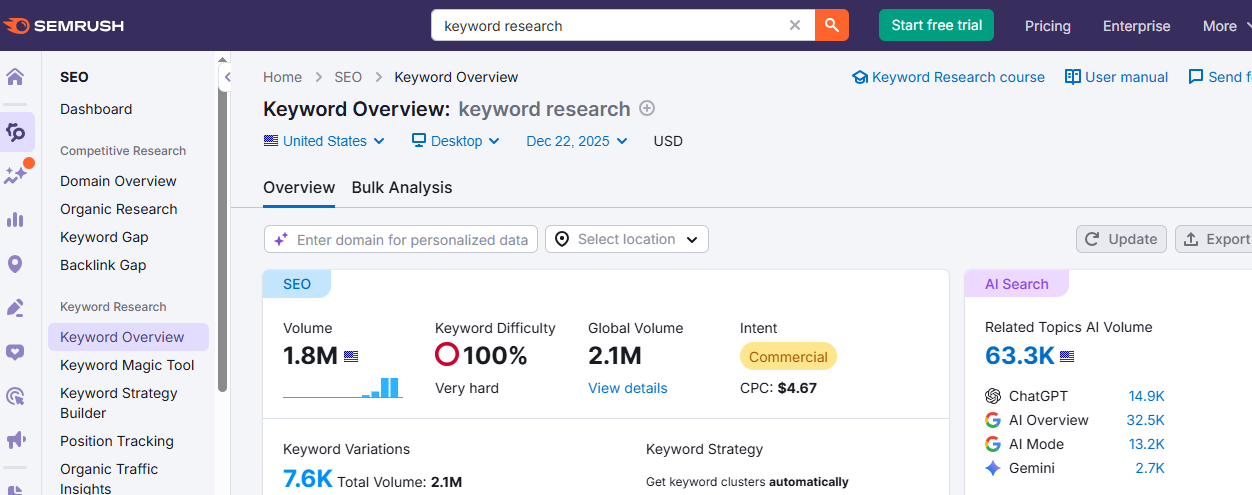
From the above images, you can see the keyword difficulty, Volume, and Intent for a particular keyword: Keyword Research.
1. Keyword selection:
Finally, you need to segregate the total keywords from all the platforms. Select the suggested ones as well.
2. Dig deeper into forums and social channels:
If you’re interested in what’s running deep in your target users’ minds, focus on what they think and say across different channels. Visiting Reddit, Quora, and other platforms could help find exactly what the user is struggling with and how to fix it. You can pick search terms from there and create content, adding relevant insights on your page.
3. Keyword Clustering:
While finding relevant keywords for your SEO strategies, you must focus on a popular practice called ‘Keyword Clustering.’ This means covering a topic for related keywords as well, making the blog comprehensive. For example, if your main page is about the Best Mobile Phones, you can create supporting articles about the Best Budget Phones, Best Camera Phones, and Phones with the Best Battery Life. Doing so will increase your chances of appearing in the search engine.
This approach also helps you avoid keyword cannibalization, ensuring you don’t accidentally create separate pages for identical terms like “best smartphones” and “best mobile phones”, which would force your own pages to compete against each other. Doing so will increase your chances of appearing in the search engine.
How to Analyze Keyword Metrics Properly
Analysis of keyword metrics is everything for better SEO optimization. Keywords that are low or moderately difficult, but with around 500 to 1000 volume, will likely perform well for new websites. Understand more below.
Focus on key areas while researching a keyword for your website:
Search volume: search volume represents how many searches there are for a keyword in a month. This decides if your content or blog post will reach a sufficient number of searchers. A general recommendation to choose a keyword is when it has around 100-1000 searches for a new website. However, zero-search volume terms are also worth adding sometimes. It might look zero, but it has the potential to have high conversions.
Keyword difficulty: Keyword difficulty is simply the metric to ascertain the competition for your keyword. This should be lower in most cases. A low KD increases the chances of performing well. Generally, for new websites, the recommended KD range is between 0-30, and 60-100 for reputable and authoritative websites are preferred, as per HubSpot.
Keyword Intent: That’s completely an approach of the website owner. Based on the intent, users should select the keyword. For instance, informational, Commercial, Transactional, and Navigational keywords.
Best Free and Paid Keyword Research Tools
A list of free and paid online keyword tools is given here. This will facilitate your keyword research process as you get various metrics to make the process easier.
| Tool | Type | Best For | Key Features | Key Differences | Price |
| Google Keyword Planner | Free | Ad volumes/India data | Search volume, forecasts, bid estimates | Official Google data; ad-focused, no KD/SERP | Free |
| Google Trends | Free | Trends/seasonality | Relative popularity, comparisons, and regions. | Time-based trends; no absolute volumes | Free |
| AnswerThePublic | Free | Long-tail questions | Visual question maps, prepositions | AIO-friendly queries; daily limits, no volume | Free |
| Ubersuggest | Free | Starter clusters | Volume, KD, ideas (3/day) | Basic SERP/ideas; caps advanced exports | Free |
| Semrush | Paid | AIO/competitors | Volume/KD/SERP/AIO tracker, AI insights | Full marketing suite, agency-scale exports | $129+/mo |
| Ahrefs | Paid | Backlinks/KD | Largest DB, Content Gap, SERP history | Deepest keyword/backlink data | $99+/mo |
| Moz Pro | Paid | On-page/E-E-A-T | Priority score, SERP features | Simpler UI, beginner-friendly optimization | $99+/mo |
| SE Ranking | Paid | Budget/local | Volume/KD/tracker, white-label | Affordable India data, solid tracking | $39+/mo |
Note: Some of the tools in the list above may offer a free trial for a limited time; after that, you will be charged according to the selected plan.
Optimizing Your Page for AEO
Once you have the keyword you want to target, it’s necessary to optimize your web page for the Answer Engine Optimization (AEO) to improve reach. Rather than completely relying on the keyword research tools, focus on AEO that requires direct and clear answers. For AEO, a certain type of keyword is favoured the most:
- Question-based queries.
- Long-tail keywords.
- Informational keywords.
Address your main query directly on your page to be cited in AI overviews or other relevant places where direct answers are required.
Common Keyword Research Mistakes to Avoid
While performing the keyword research process, website owners can make mistakes that can ruin their overall SEO strategy. What are those mistakes? Check below!
1. Neglecting Keyword intent:
Sometimes, while researching the right or business-specific keyword, we miss the intent of the keyword – what the user is trying to get or seek. As a result, we end up covering the topic based on our observation, but not according to what’s required. Therefore, we should focus on intent more than any other metric in the first place.
2. Ignoring competitor Analysis:
Your competitor is your guidance in terms of keyword selection. Your analysis of their entire keyword strategy may help you decide which keywords are worth considering and which aren’t.
3. Keyword stuffing:
An excessive use of keywords can be fatal to your SEO growth. Keywords that are placed at random, without actually having contextual meaning, are called keyword stuffing. This strategy is a poor signal to search engines that you’re unintentionally placing keywords, reducing the quality of the text.
4. Relying on a single tool:
Marketers make the mistake of using only one keyword research tool, while there are a variety of others that provide better metrics. Sticking to one limits your research; as a result, you end up losing relevant keywords because you didn’t find them.
A Real Example of Keyword Research at SpinOnWeb
Here, we will give you the entire process of KEYWORD RESEARCH WE DID ON SPINONWEB AND PRODUCED RESULTS.
So, I was looking for a keyword on which I can rank easily. The only thing I had in my mind was: Seed Keyword.
And it was “snapchat plus”
So, as usual, I started with the manual process of finding a keyword.
Entered the query in the search bar and got variety of queries.
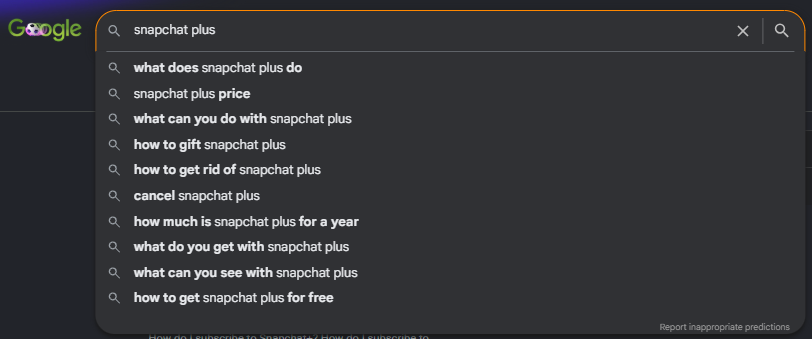
This makes me think: people are searching for ways to get a Snapchat Plus subscription. I also used the Semrush keyword magic tool and got this.
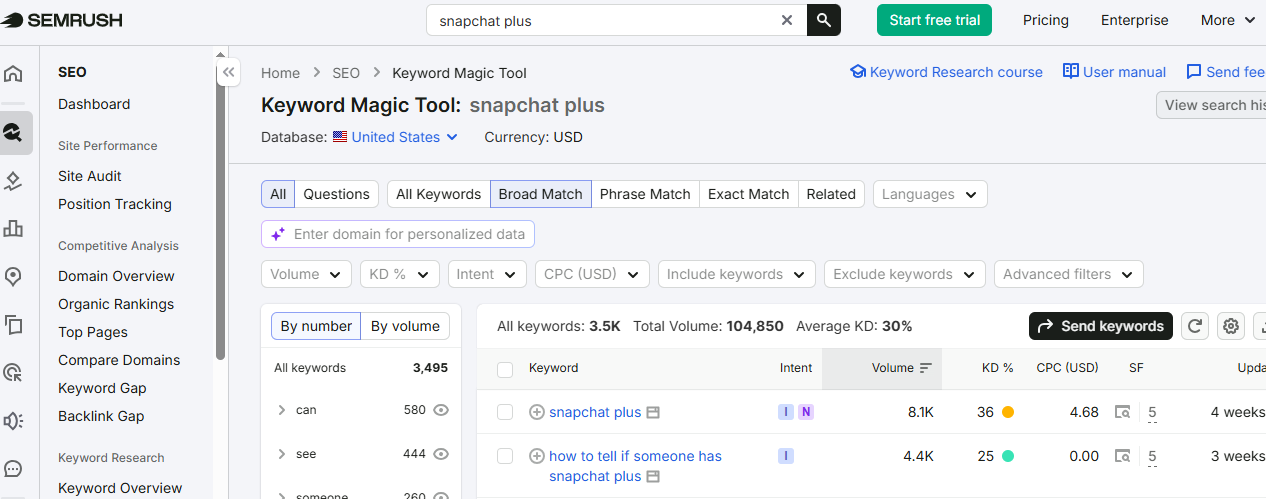
There I saw a keyword potential: how to tell if someone has snapchat plus.
Users were fascinated to know who else is using Snapchat – how to find them. Also, the metrics defined the query is worth including. It says:
- Volume: 4.4K
- KD%: 25 (which is ideal for ranking)
- Intent: Informational
So, I considered this keyword, and the next move was to find competitors’ strategy over this. So, I visited Google with this keyword and found this:

Reddit was ranking on the first page after 1 or 2 results. That means I had the chance to rank my web page if I cover the topic well. I did the same.
And guess what?
My Page is ranking at the top of SERPs for this term.

That’s where the role of choosing the right keyword comes in.
You can have competition for the keyword, but if you have selected the correct keyword and created useful, valuable content for users, you can rank it easily.
Just in case you are out of your mind about where to start your keyword research or content process, our affordable content services help your brand reach its goal by incorporating the right keyword research and intent alignment solutions we offer.
In the process of finding the right keyword, we:
- Analyze your business and understand who your target audiences are.
- Understand the goal and find the related keywords aligned with business goals.
- Analyze competitors’ keyword strategy and find the ‘opportunity keywords’ while maintaining business objectives.
- Place the keywords naturally at relevant spaces within a copy – meta title, meta descriptions, introduction, and the middle of the copy.
Summary
Keyword research is the foundational research for your entire SEO strategy. By identifying keywords, you can understand your target users and make strategies to fulfil their needs. Many tools are available for keyword research – both free and paid. Free tools may offer fewer metrics than paid ones; that depends on your individual research. Now, you have a basic idea of how to do keyword research for seo. Hope this contributes to your SEO journey!😊 Find the right keywords matching your business goals, understand intent well, create content, and conquer the web.
FAQs
How many keywords per 1000 words?
Regarding ideal keyword inclusion, for every 100-word content, the ideal keyword percentage should be between 0.4% and 0.5%. However, in the current scenario, natural keyword inclusion is the focus.
Can I use ChatGPT for keyword research?
Generative engines like ChatGPT can be one of the options for Keyword research. This helps in understanding the users’ query much deeper than the serps.
What are the 4 pillars of SEO?
The four pillars of SEO are Content, On-page optimization, Off-page optimization, and Technical SEO.