When you need to make a quick decision or are in a playful mood, there’s an online, always-available tool you can use for fun or tie-breaking. I am talking about Google Coin Flip.
This browser-based coin-flipping feature is the perfect tie-breaker when you’re torn between two options. Earlier, physical coin flipping was used to decide between two scenarios. Whatever outcome you get (heads or tails), you would make a decision based on that. But today, in 2026 and beyond, we flip the coin online, not with a real coin.
We visit Google, type “coin flip,” and click Flip. In less than two seconds, we have the answer.
A few of you might have doubts about the fairness of this online coin-flipping game. Is it really accurate? Is it biased? How to use it, and how is a computer even flipping a coin? Let’s discuss all in one guide.
Google Coin Flip at a Glance
| Feature | Details |
| Full Name | Google Coin Flip (also called Google virtual coin flip or Google coin toss) |
| Access | Built into Google Search — no separate app or URL needed |
| Cost | Completely free |
| Platforms | Desktop browsers, Google Chrome, Android, iPhone (any browser) |
| Result | Heads or Tails, displayed with animation |
| Repeat Use | Click Flip as many times as you like |
What Is Google Coin Flip?
Google Coin Flip is a free, browser-based virtual coin toss tool built directly into Google Search. It appears to simulate a random heads-or-tails result inside Google Search. No app download, no account, no cost. And no, it is not rigged.
To access Google Coin Flip, search for “flip a coin” or “coin flip” in Google Search, and the heads-or-tails tool usually appears at the top of the results. Click the Flip button, and the animated coin spins before landing on either Heads or Tails.
Google Coin Flip is best used for casual, low-stakes decisions such as choosing who goes first, settling a friendly tie, or making a quick yes-or-no style choice.
How to Use Google Coin Flip in 5 Simple Steps
Anyone can use Google’s coin flip feature in seconds – no setup required. Just follow the steps in your browser as presented below:
Step 1: Open any browser on your phone, tablet, or computer.
Step 2: Go to Google.com or use the Google app.
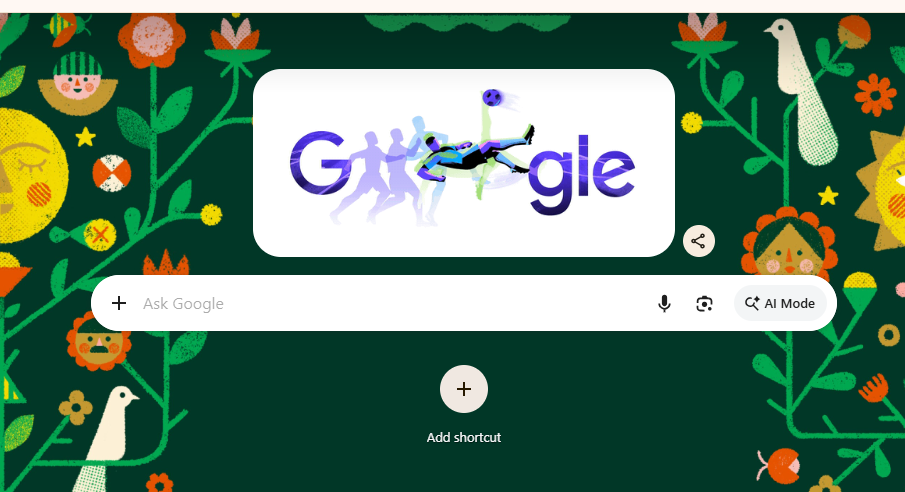
Step 3: Type any of these search terms into the Google search bar:
- “flip a coin”
- “coin flip”
- “Google coin flip”
- “heads or tails”
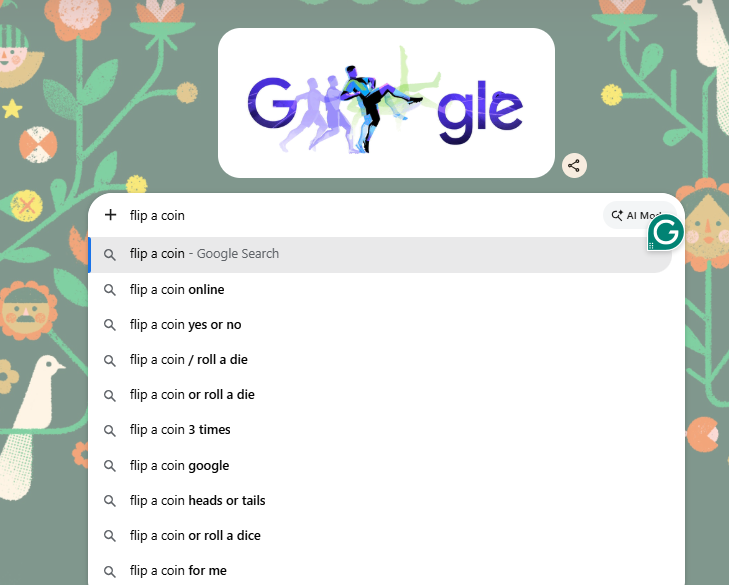
Step 4: The coin flip tool appears at the top of the results. Click or tap the Flip button.
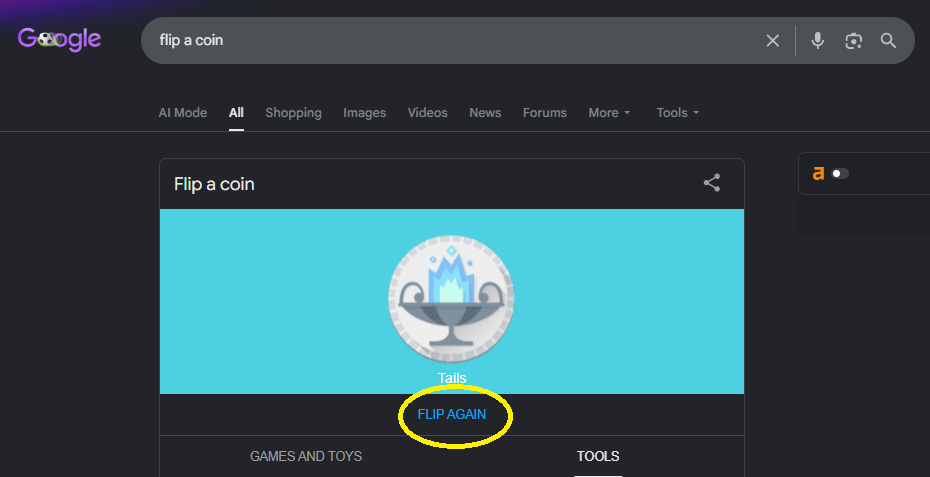
Step 5: Watch the coin animation and see your result: Heads or Tails.
Note: You can click ‘Flip again’ as many times as you like to get a new outcome each time
Does Google Coin Flip Really Give a 50/50 Result?
For everyday use, Google Coin Flip is intended to behave like a fair 50/50 heads-or-tails tool, although short runs can still look uneven.
So, when I was searching what others are saying about the result probability, I got this that I am sharing here:
One user on Reddit was commenting: When you are flipping the coin in even intervals (even numbers), the results you get are heads. And for odd numbers, tails is produced.
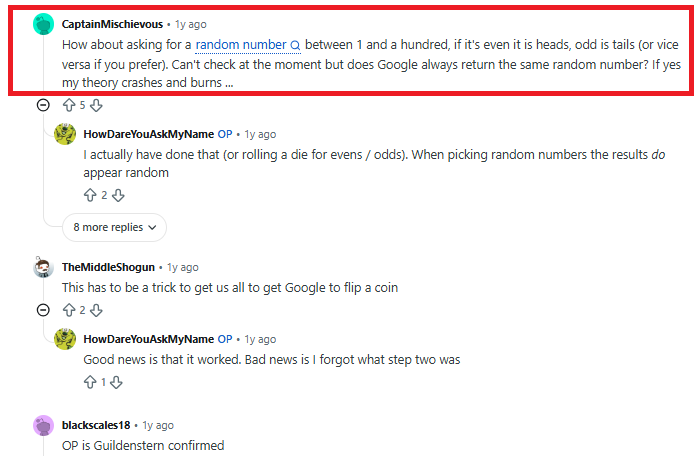
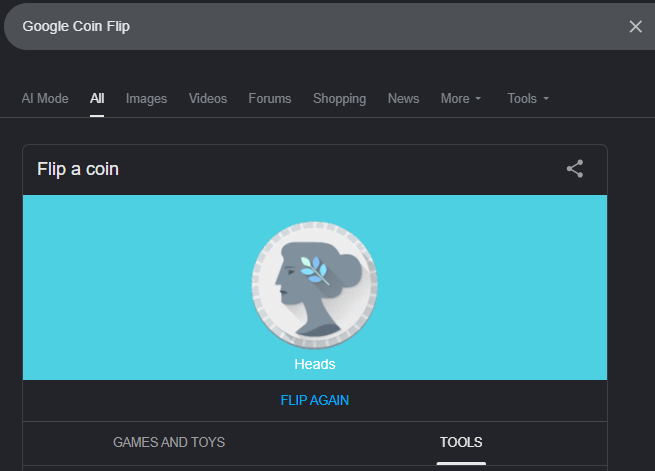
Once I checked that, there was nothing like that. In my observation, I have flipped the coin thrice and got Heads. That does not prove anything by itself, but it does show why short sequences should not be used to infer a hidden rule.
Below is the result I got after flipping coin three times in a row. You can see heads is the result.
In fact, under the same comment, another user posted a comment saying: “I actually have done that (or rolling a die for even/odds). When picking random numbers, the results do appear random.”
This clears the doubt that the results you get with each coin flip are random; no presumptions can work because it produces random results with every try.
The result of each flip is statistically independent. That means what happened last time has zero effect on this flip. Even if you get ‘Heads’ five times in a row, the next flip is still 50/50.
If It’s Unbiased, Why Don’t You Get Exactly 50 Heads and 50 Tails?
Here’s where many people get confused. If you flip a coin 10 times, getting exactly 5 heads and 5 tails is just one of many possible outcomes.
Over millions of flips, the results converge toward 50% each. But in short sequences like 10 flips, 20 flips, even 100 flips, natural variation means you will often see slight imbalances. That is not bias. That is probability behaving exactly as it should.
As a simple manual observation, I recorded 100 flips to see how the results were distributed:
| Flip Number | Observed Result |
| Flip 1 | Heads |
| Flip 2 | Tails |
| Flip 3 | Tails |
| Flip 4 | Heads |
| Flip 5 | Tails |
| Flip 6 | Heads |
| Flip 7 | Heads |
| Flip 8 | Tails |
| Flip 9 | Heads |
| Flip 10 | Tails |
| Flip 11 | Tails |
| Flip 12 | Heads |
| Flip 13 | Tails |
| Flip 14 | Tails |
| Flip 15 | Heads |
| Flip 16 | Heads |
| Flip 17 | Tails |
| Flip 18 | Heads |
| Flip 19 | Tails |
| Flip 20 | Heads |
| Flip 21 | Heads |
| Flip 22 | Tails |
| Flip 23 | Heads |
| Flip 24 | Tails |
| Flip 25 | Tails |
| Flip 26 | Heads |
| Flip 27 | Tails |
| Flip 28 | Heads |
| Flip 29 | Heads |
| Flip 30 | Tails |
| Flip 31 | Tails |
| Flip 32 | Heads |
| Flip 33 | Heads |
| Flip 34 | Tails |
| Flip 35 | Heads |
| Flip 36 | Tails |
| Flip 37 | Tails |
| Flip 38 | Heads |
| Flip 39 | Tails |
| Flip 40 | Heads |
| Flip 41 | Heads |
| Flip 42 | Tails |
| Flip 43 | Heads |
| Flip 44 | Tails |
| Flip 45 | Tails |
| Flip 46 | Heads |
| Flip 47 | Tails |
| Flip 48 | Heads |
| Flip 49 | Heads |
| Flip 50 | Tails |
| Flip 51 | Tails |
| Flip 52 | Heads |
| Flip 53 | Heads |
| Flip 54 | Tails |
| Flip 55 | Heads |
| Flip 56 | Tails |
| Flip 57 | Tails |
| Flip 58 | Heads |
| Flip 59 | Tails |
| Flip 60 | Heads |
| Flip 61 | Heads |
| Flip 62 | Tails |
| Flip 63 | Heads |
| Flip 64 | Tails |
| Flip 65 | Tails |
| Flip 66 | Heads |
| Flip 67 | Tails |
| Flip 68 | Heads |
| Flip 69 | Heads |
| Flip 70 | Tails |
| Flip 71 | Tails |
| Flip 72 | Heads |
| Flip 73 | Heads |
| Flip 74 | Tails |
| Flip 75 | Heads |
| Flip 76 | Tails |
| Flip 77 | Tails |
| Flip 78 | Heads |
| Flip 79 | Tails |
| Flip 80 | Heads |
| Flip 81 | Heads |
| Flip 82 | Tails |
| Flip 83 | Heads |
| Flip 84 | Tails |
| Flip 85 | Tails |
| Flip 86 | Heads |
| Flip 87 | Tails |
| Flip 88 | Heads |
| Flip 89 | Heads |
| Flip 90 | Tails |
| Flip 91 | Tails |
| Flip 92 | Heads |
| Flip 93 | Heads |
| Flip 94 | Tails |
| Flip 95 | Heads |
| Flip 96 | Tails |
| Flip 97 | Tails |
| Flip 98 | Heads |
| Flip 99 | Tails |
| Flip 100 | Heads |
In this small manual test, the results were 48 heads and 52 tails, which is close to an even split. A sample of 100 flips is not enough to prove fairness, but it does show that short-run variation is normal.
How Does Google’s Coin Flip Generate Random Results?
The results are generated by automated systems called Pseudo-random number generators and seeding. This is a mathematical algorithm that produces a sequence of numbers that appear random, even though they come from a formula.
Google’s coin flip uses a PRNG seeded with values like the current time in milliseconds and other system-level data. The algorithm picks a number, determines whether it falls in the “heads” half or the “tails” half of a range, and displays the result.
Here is a detailed breakdown:
- Pseudo-random number generation (PRNG): Google’s coin flip uses an algorithm (likely based on the browser’s built-in Math.random() function or a similar PRNG) that generates a number between 0 and 1. If the number is below 0.5, it’s Heads. If it’s 0.5 or above, it’s Tails.
- Seeding: The PRNG needs a starting point, called a seed. Google uses dynamic values (like the exact time in milliseconds when you click Flip) to seed the generator. This makes it practically impossible to predict or manipulate the outcome.
Google Coin Flip vs Other Online Coin Toss Tools
Google isn’t the only option for a digital coin flip. Here’s how it compares to other popular tools:
| Feature | Google Coin Flip | Random.org | Calculator.net | Virtual Coin Toss Apps |
| Truly random? | PRNG (very good) | Hardware RNG (best) | PRNG | Varies |
| Free? | ✅ Yes | ✅ Yes | ✅ Yes | ⚠️ Some paid |
| Ads? | ❌ None | ✅ Minimal | ⚠️ Some ads | ⚠️ Often heavy ads |
| Requires app? | ❌ No | ❌ No | ❌ No | ✅ Yes |
| Mobile friendly? | ✅ Yes | ✅ Yes | ✅ Yes | ✅ Yes |
| Fastest access? | ✅ Fastest | ⚠️ Extra steps | ⚠️ Need to navigate | ⚠️ App download |
| Animation? | ✅ Yes | ❌ No | ✅ Basic | Varies |
Note: Random.org uses atmospheric noise to generate true hardware randomness, which is technically more random than Google’s PRNG. But for everyday coin flip decisions, the difference is completely irrelevant. Both produce outcomes that are functionally indistinguishable from a fair coin.
Does Google Have a Coin Flip App?
Google does not have a dedicated coin flip app, no Google coin flip APK to download, and no separate Google coin flip Android or iPhone app. The coin flip tool lives entirely inside Google Search itself.
This means you never have to install anything. Every device that can access Google can flip a coin. It works on:
- Android phones and tablets (via Google app or any browser)
- iPhones and iPads (via Safari, Chrome, or any browser)
- Windows and Mac computers
- Chromebooks
- Smart TVs with a browser
When Should You Use Google Coin Flip?
Any time you need a fast, fair, binary decision with no emotional attachment to either outcome. Some common uses:
- Deciding who goes first in a board game or card game
- Sports: calling the toss at the start of a game
- Classroom activities where a fair random choice is needed
- Splitting chores or tasks between two people
- Settling friendly bets when no coin is available
- Decision-making when you’re equally torn between two options and want to break the tie
- Quick draws in trivia or game nights
- Remote teams needing a fair randomizer over video call
A note on decision-making: There’s a well-known trick where you flip a coin not to follow its result, but to check your emotional reaction to the result. If it lands on heads and you feel relieved, you secretly wanted heads. This works because the coin externalizes the decision.
Pros and Cons of Google Coin Flip
| ✅ Pros | ❌ Cons |
| Free and always accessible | Requires internet connection |
| No app download or account needed | Cannot simulate specific coin designs |
| Works on all devices and browsers | No multi-coin flip option (e.g., flip 10 at once) |
| Produces fast result in under 2 seconds | No history or statistics tracking |
| No ads cluttering the experience | Animation may feel superficial to some |
| Consistently fair 50/50 probability | Uses PRNG, not true hardware randomness |
| Clean, simple interface | Not available offline |
Common Myths About Google Coin Flip
Myth 1: “It remembers previous flips and adjusts.”
False. Each flip is completely independent. Google’s coin flip has no memory of past results and makes no adjustments based on history. Mathematically, this is called statistical independence.
Myth 2: “It favors tails.”
No evidence of this. People who believe this are usually experiencing confirmation bias — remembering the tails results and ignoring the heads results.
Myth 3: “Results change based on your location.”
Completely false. The randomness algorithm has nothing to do with your geographic location, IP address, or device. A flip in New York and a flip in Los Angeles use the same process.
Myth 4: “It’s not actually random — it’s a pattern.”
PRNG results are not truly random in a pure mathematical sense, but they are statistically indistinguishable from randomness for all practical purposes. No one has found a pattern that would allow prediction of results.
Myth 5: “Google manipulates it to influence decisions.”
There is zero evidence of this and no logical motive. Google would have nothing to gain from manipulating coin flips — and everything to lose in terms of user trust if they ever do so.
Frequently Asked Questions (FAQs)
Does It Work on iPhone and Android?
Yes. The Google Coin Flip tool works on any device with a web browser. On Android, you can also use the Google app directly. On iPhone, it works through Safari, Chrome, or any other browser when you visit Google.
Is the Google coin flip really 50/50?
Yes. While individual flip sequences vary by chance, the underlying probability is a true 50/50.
How rare is 7 heads in a row?
It’s rare, but entirely possible due to natural variance. The odds of getting 7 heads in a row are 1 in 128 (0.78%). Every flip is independent, so getting heads six times doesn’t lower the chance of heads on the seventh.
What happens if you flip a coin 1000 times?
If you flip a coin in Google 1,000 times, the results will average out close to 500 heads and 500 tails, though you may see long streaks of consecutive heads or tails along the way.
Is a coin flip truly random?
Yes, every time you flip a coin, there’s an equal probability of getting heads and tails.
Final Say!
Google offers multiple integrated tools like Google Coin Flip, Google Spirit Level, and many others. These tools are fun and useful in day-to-day life. You can try them out from your browser on Google Search. This guide is a complete discussion about Google flip a coin – how it works, whether it’s biased or not, and also how you can use it simply.