The internet has never had more content than today. And ironically, it has never been harder to get noticed. In a research, every 1 page out of 10 with a .com domain has used AI to produce the content. And this goes as double the share on .org domains, around 4.6%.
AI changed the content creation process forever. Generative AI tools like ChatGPT, Gemini, and Claude let anyone produce the desired piece of content with just a prompt.
But whether that content will perform well on the web is not certain. Mostly, the generated content lacks the ability to earn attention and trust. Therefore, you need to learn why AI content needs quality, not quantity. And what does quality content actually mean?
If you are publishing more AI content and wondering why the results feel flat, this guide is for you. I will show some practical real-life examples to understand the difference between AI-written content and human-written content. Plus, how to create quality content that stands out.
Impact of AI in Content Production
AI Made Content Creation Easy. But that does not mean you will find quality content every time you enter a prompt on these AI tools.
A few years ago, publishing 20 solid articles a month required real resources. Writers, editors, subject-matter experts, time. But now, AI has changed the game entirely.
The result?
Millions of AI-generated articles are published daily. Every niche is now saturated with content that looks polished, sounds confident, and says almost nothing new.
But the reality is: AI does not generate knowledge; it generates patterns assembled from existing knowledge.
That means your content’s message may already be present on the web. And yours will become the copy of them.
For readers, this creates information overload.
For search engines, it creates a signal-to-noise problem. And for brands chasing traffic through volume, it creates an invisible ceiling.
Does Google Penalize AI Content?
Now, you must have a question: does that mean Google penalize AI-generated content? In reality, Google does not consider the way you have chosen to produce the content; it’s the content’s quality, usefulness, intent fulfilment, and originality that search engines look for and rank accordingly, as per Google’s helpful content update.
I will show you how AI content still ranks from one of my blog’s page analyses: https://www.spinoneducation.com/cbse-result/.
In this blog, AI content is used (around 60%), but it still ranks on search engines. Below is the visual AI detection for this blog on the ZeroGPT AI detector tool:
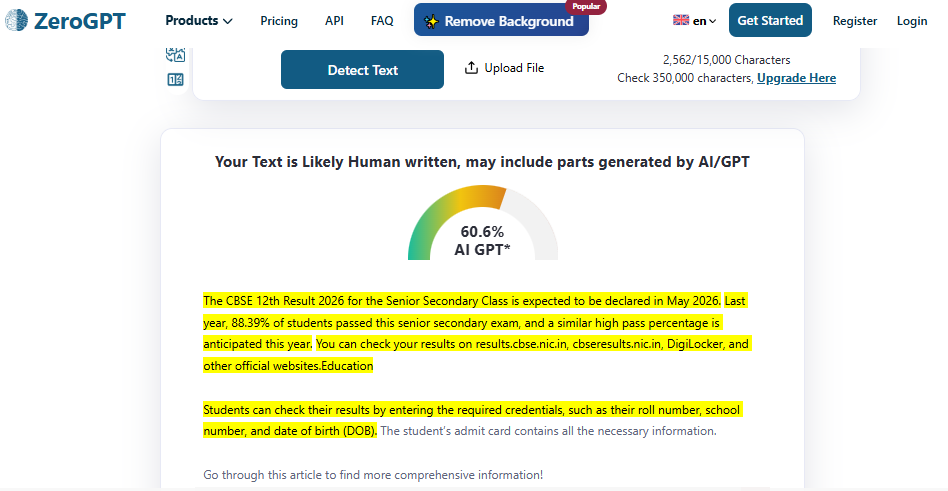
You know why it’s ranking?
Because it is written with the user’s intent in mind. The keyword (CBSE 12th Result) is specifically addressed, keeping the students in mind, and includes all the necessary headings, like result date, process to check results, what after the result, etc.
Which makes it worthwhile to be a part of SERPs for this query.
In other words, Google does not penalize AI content; It penalizes low-value content, having no real experience shown, and most importantly, written for commodity niches.
This falls under the scaled content abuse, where content creators focus on creating content to manipulate search engines, not to give value to the readers.
Google looks for these in the content before deciding it’s worth ranking:
- Is this original?
- Is this useful?
- Does it serve real user intent?
Therefore, you can use AI for research purposes, taking ideas for content structure, but not to write entire content using it. That might violate the content policy and result in lower rankings.
Why Quantity Alone Doesn’t Work Anymore
Publishing More Doesn’t Mean Ranking More. Many other parameters should be considered, like content structure, quality, intent fulfilment, and others, before you expect a page to rank.
One example of my own blog clears the picture of this concept.
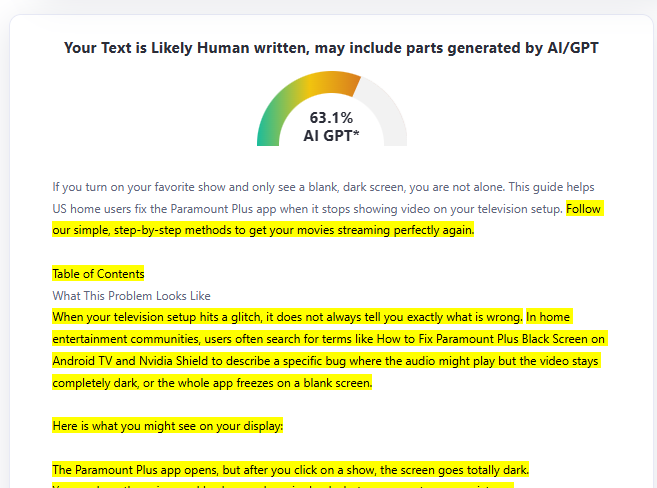
So, I have written content (basically asked AI to write for me) on the query: How to Fix Paramount Plus Black Screen on Android TV. The content did not perform well on the web – zero visibility.
The reason?
The content production process was similar (used AI), but the content lacked real-life examples, originality, and intent; basically, it had everything not likely to rank.
This means, no matter how long you write on a topic, if it lacks the necessary components that make it unique, original and intent-focused, you will lose the game.
Here we elaborate each point in detail:
1. Content Saturation
The topic you selected has been covered largely by others. This means whatever you try to cover has been covered by others, and there’s no uniqueness left for the topic. So, no matter how lengthy the content is, the unique point is missing – and so is the scope of ranking.
2. AI-Generated Sameness
Content structure is the same as others. When you use an AI tool (Gemini, ChatGPT, Claude, etc.), the blog structure like h1, h2, h3 will be the same (if given the same instructions to AI tools). This makes your blog low-performing because a similar structure is already ranking on the web.
3. Topical Duplication
Creating content on the same topic but with a little bit of twist is not going to perform well. Google or any search engine is smart enough to detect what you’ve covered, and accordingly, your rankings will be affected. Not creating a unique, detailed guide will cost you ranking stiffness.
4. No Usefulness, Just Volume
That’s today’s topic as well. Generating or writing content in large volume without focusing on usefulness will lose its place. Whether the content is useful (users can get informed, take action further, and get some value) or not decides whether it will perform on the web.
What High-Quality AI Content Actually Looks Like
Quality content will always focus on fulfilling the following criteria:
- Useful content
- Research included
- Real-life examples
- Attention to detail
- Fulfilling the intent
Now, when you look at these terms, some might look familiar to you. The focus is to implement all of these into your blog.
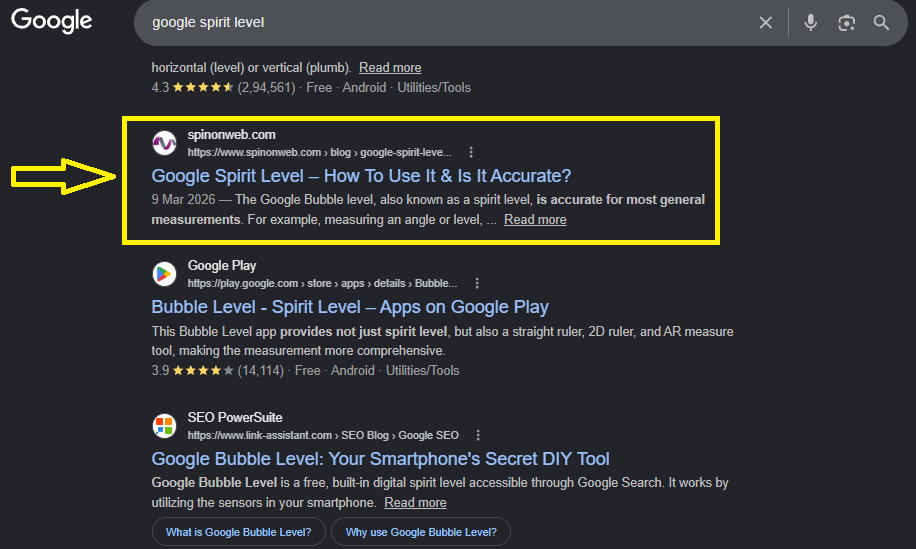
And I have implemented those practices in my blog: Google Spirit Level
In this blog, I have incorporated all the necessary elements needed for a quality blog.
- I have included quick notes to know quickly about the page.
- I have discussed the accuracy of this tool, and who should use it.
- I also mentioned the quick troubleshooting steps to fix this tool on your device.
- Also, included clips and pictures of each step to make it more real.
And the result of this?
Getting the rank on this page.
Here is what you get from this. Your content needs to have:
Original Insights
Something your reader could not find on any other page. It could be your team’s data, client observations, or specific research you have done for the keyword. Something that required a brain connected to real-world experience.
First-Hand Experience
This is the hardest thing to fake and the most valuable thing you can offer. So, as you can see in the above example (Google spirit level), I have included real pictures and screenshots while performing the steps. This shows how the tool actually works. This is unique and first-hand experience, and therefore rewarded.
Original Research
Originality is one crucial aspect that can signal search engines that your page is worth including for the related key terms. In my blog, I have conducted research on the topic (Google spirit level) on official platform, and other discussion forums. Gathered the information and created the post.
Clear Structure
One more essential component to rank better on serps or in AI engines is to structure the content well. In fact, the well-structured content helps readers, search engines, and artificial intelligence enginces like ChatGPT, Claude, Perplexity to understand and cite your web page.
Accurate Sources
Every factual claim should be traceable to a credible, named source. This is a trust signal for readers and a quality signal for search engines. It’s actually the ‘T’, which means Trustworthiness, one of the quality signals from EEAT (Experience, Expertise, Authoritativeness, and Trustworthiness).
Helpful Visuals
Using Images, diagrams, charts, or screenshots that genuinely illustrate a concept is always helpful. Multimodal contents perform better in AI Overviews and drives higher engagement.
Expert Opinions
An attributed quote from a subject-matter expert does more for your content’s credibility than five paragraphs of well-written generalities. Experts provide accountability. They signal that humans with stakes in being right have reviewed what you are saying.
How to Use AI Without Sacrificing Quality
Let’s understand, after a lot of discussion about how quality content looks, about how you can create quality content using AI. This will be just for the demonstration purpose.
So, the focus should always be to use the AI for saving time, researching well, and ultimately create a copy that ranks well on search engines, and getting cited in AI overviews or ai engines.
Let’s start!
Step 1: Research with AI
Use AI to quickly map a topic, surface related questions, identify subtopics you might miss, and compile background information. This is where AI saves the most time with the least risk.
Step 2: Validate facts
Before drafting, verify any statistics, claims, or named examples against primary sources. This is important because AI may hallucinate on things. Therefore, every factual claim needs a check.
Step 3: Add expert insights
Include useful insights coming from your own team’s knowledge, your first-hand experience,
Interviewing a subject-matter expert, and so on. This is the step that makes your content genuinely different.
Step 4: Include real examples
Use real examples in the content. It builds trust and gives a clear view of the discussion. For example, while writing this post, I am mentioning real data, screenshots, and information that gives you enough idea about the topic.
Step 5: Let AI improve readability
Once you are done with the writing part, you can paste the content in AI tools and ask to check the readability and scope of improvement. That works well to align the content and saves a lot of time.
Step 6: Include relevant sources
As mentioned, even if you are takin the idea from AI to create content on a keyword, focus on citing the original source you have used while creating the content. These external sources could be your peer-reviewed studies, official documentation, credible journalism. This builds trust with readers and signals quality to search engines.
Step 7: Human edit before publishing
Edit before you press the ‘publish’ button. This means, checking your content on multiple areas like brand voice, your audience, and your standards. Review the piece before it goes live. No exceptions.
The Future of Content Is Not Human vs. AI
The “human vs. AI” framing is the wrong way to think about this. The actual productive work will be possible both AI and Human work together.
How AI helps:
AI accelerates production. It reduces the time spent on outlines, first drafts, formatting, research compilation, and SEO structure. Those are real, meaningful efficiency gains. A content team that ignores AI will work harder for the same output.
How human intervention is important
But AI cannot replace the things that actually make content worth reading.
- It cannot replace your brand voice.
- It cannot provide editorial oversight.
- And it cannot produce the differentiation that comes from real human expertise and perspective.
The brands winning the content game right now are running hybrid operations. AI handles the scaffolding; humans create the substance. Editorial oversight ensures consistency and accuracy.
The more AI is used, the more valuable human perspective becomes.
Want to Create Valuable Content for Your Business?
Being an active digital marketing agency, we understand the roller coaster ride of AI content on search engines. Also, we understand how to humanize the content, make it specific to business goals, and make it absolutely for the target audience. If you are struggling with content production and content optimisation, you can connect with us and get the best content services aligned with your business goals.
Frequently Asked Questions
Is AI-generated content bad for SEO?
AI-generated content is not bad for SEO. It’s just a generic piece of content that may not be valuable for readers and not optimized for search and AI engines.
Does Google know if content is AI-written?
Yes, Google has machine learning models and automated ranking systems to detect if a piece of content is written by human or machine. Anything that lacks the human experience is likely generated by AI.
How much human editing should AI content receive?
That depends on the goal. But, to make the content useful and valuable for your target audience, you need someone who understands your goal very well. Spinonweb can handle the editing for you.
What makes AI content high quality?
Content written primarily for users, including real-life experiences, original insights, deep coverage, and multimedia usage, makes AI content quality content.
Can AI content rank without human input?
It is difficult to rank AI content without human intervention. A real human experience is what is rewarded and helps get the rank.
How does E-E-A-T apply to AI-assisted content?
By providing hands-on experience, deep research, building topical authority, and citing primary useful resources, you can achieve EEAT in AI-generated content.